
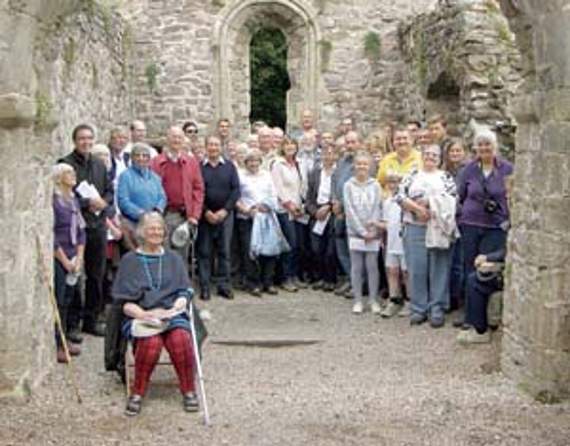
ONE hundred and fifty years after the last regular service was held, the tiny, abandoned and historic hamlet of Lancaut, on a peninsula near Chepstow, has echoed once more to the sound of singing from its church building.
In a joint community venture, which included trustees from the Forest of Dean Historic Buildings Trust which owns the site, parishioners from the churches from the Parish of Tidenham, members of Tidenham Historical Group, local residents, and landowners, gathered once more at the site of the ancient church of St James to celebrate the end of a period of conservation of the historic building.
The restoration project has included rebuilding completely collapsed west chancel arch, the walls stabilised, and the site prevented from sliding down towards the river.
The large gathering made its way down across fields and steep woodland paths to the picturesque location on the banks of the river Wye and to hear Rev David Treharne, the Vicar of Tidenham, open the service starting with a passage written in 1830 by Eleanor Ormerod, young daughter of a local antiquarian and wealthy landowner, where she described the “exceeding picturesqueness of the spot which might have furnished an excellent subject for a painting” and reflecting how wretched she felt as a young child, squashed into the family pew in the small church unable to move while others stood outside and “disposed themselves on the grass where they had full enjoyment of the fresh summer air and heard [the service] through the open door”.


As he led the service of prayers, well-known hymns and a reading with the theme of nature in all its variety, Rev Treharne reflected on the very special history and nature of the location which seldom fails to inspire and move the spirit of everyone who visits.
Two unaccompanied songs were also sung as part of the service by east European guests from Georgia who regularly visit the area.
There has been evidence of a Christian church dedicated to St Cewydd in the tiny, then fishing, community of Lancaut since 625AD.
Later, extended and rebuilt under Norman rule, the name changed to St James, and worship continued until regular monthly services stopped in 1865 when the roof became unstable and was removed.
A regular single annual summer service continued until the onset of the Second World War and was later revived between 1996 and 1999.
The building was de-consecrated in 1987 and responsibility transferred over the years to a variety of preservation societies, most recently to the Forest of Dean Historic Buildings Preservation Trust in 2013.
As part of the service one of the trustees explained that, through several funding awards and donations, plus the support of the local landowner Mr Evans, they had been able to conserve the building and halt the gradually collapsing walls.
Organisers have said that although the rebuilt stonework now looks rather bare it will soon be capped with turf and, in a few years time it will begin to mellow and blend in with the natural surroundings once more.
Speaking about the event, Rev Treharne said: “I am delighted to be part of this local initiative, that is not only about the preservation of an ancient building for future generations but one that reminds and draws people to a local treasure in an area of outstanding and captivating natural beauty and history. “As we clambered down and gathered on that sunny September day enclosed by the old church walls of St James, although now deconsecrated, I think most of us, if not all, were able to say ‘truly the Lord is in this place.’”
He added: “I hope we will gather again for a service in 2016.”
Comments
This article has no comments yet. Be the first to leave a comment.