

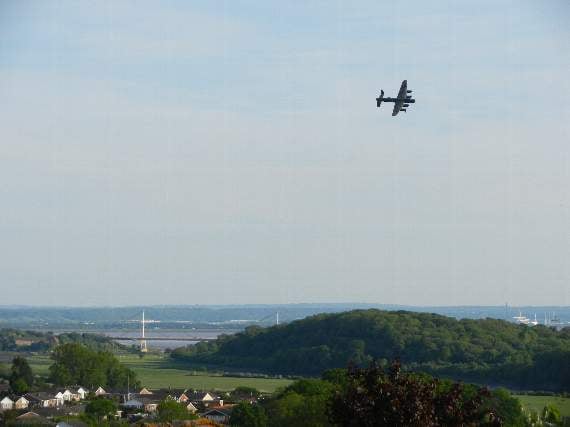
One of the heroes of the Second World War Dambuster bombing raids was commemorated with a blue plaque on his Chepstow home and a flypast of a plane like the one he flew in last Thursday (May 17).
Up to 500 people gathered outside the former home, in Chepstow’s Hardwick Avenue, of Flt Sgt Bill Townsend, who won the Conspicuous Gallantry Medal and Distinguished Flying Medal for his wartime service with the Royal Air Force’s 617 Squadron.
The former Monmouth School pupil, later promoted to flight lieutenant, led the final wave of Lancaster bombers on the dams on May 17, 1943, and the unveiling of the commemorative plaque outside his home took place exactly 75 years later to the day.
An Avro Lancaster 474 flew in from the east and circled three times above Chepstow’s Garden City before heading on towards Cardiff for further commemorative events.




The plaque was designed, made and donated by Ned Heywood MBE and the public ceremony included a speech from Chepstow mayor Dale Rook as well as a the fly-past from the Lancaster.
The Dambusters theme was played by members of Chepstow Community Band.
A spokesperson for Chepstow Town Council said: “We had a few hundred people at the event and that included a contingency of around 40 members of Bill Townsend’s family.
His two daughters attended and were overwhelmed by the attendance and by the emotion of the occasion.
“Air Commodore Simon Ellard unveiled the plaque dedicated to Bill, who died in 1991. And then the flypast took place. It was fabulous. We were only expecting it to go over once, but it circled around three times.
“The event was an initiative between the town council and the Royal British Legion, with the participation of the RAF.
“Commander Bob Grattan was the person who sowed the seed of the idea a year ago and it was wonderful to see it come to fruition.”
The raids, officially code named Operation Chastise were immortalised in a 1955 film The Dam Busters starring Michael Redgrave.
They targeted three dams, the Möhne, the Edersee, and the Sorpe, all of which supplied water to the German war effort, using ‘bouncing bombs’ developed by Barnes Wallis.
Two of the dams were successfully breached and an estimated 1,600 civilians, including Allied prisoners of war, lost their lives in the resulting inundation.
The action destroyed factories and farmland, as well as reducing water production, and boosted public morale in Britain.
Comments
This article has no comments yet. Be the first to leave a comment.