

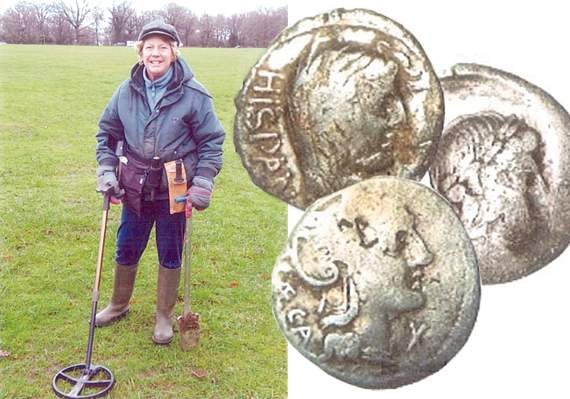
A DREAM find for a Forest metal detectorist started off with a piece of farm machinery and a couple of ‘grots’.
But that led to the “once in a lifetime” discovery of a hoard of 2,000-year-old silver Roman coins for detectorist Susan Hurrell of Cinderford.
What makes the collection of eight silver denari coins unusual is that they all pre-date the Roman invasion of Britain in AD43.
The oldest of the coins has been dated by the British Museum to 134BC during the time of the Roman republic before the first of the emperors.
.jpeg?width=209&height=140&crop=209:145,smart&quality=75)



All but one have been dated to Before Christ with the other having been minted during the reign of the Emperor Tiberius who reigned between AD14 and AD37.
The ‘scattered’ hoard was discovered in a field in the Forest on a Monday evening in October last year with each coin within a few feet of the others.
Susan said: “To come across one denarius is a miracle, to get another seven on the trot is amazing
Susan was with friend Alan Ward and together they run Forest Searchers which includes a finding service for lost metal objects – which is where the discovery really begins.
A farmer called Susan at her home asking for help to locate a locking pin from a tractor which had been lost in the field.
Alan said: “He wanted to plough the field to sow a crop but he didn’t want to leave this thing in the ground because it might damage the ploughing equipment.
“It was a big field, about 25 acres, but he gave us a rough area and we started searching.”
The pin was found and the pair headed back toward the gate, detecting as they went and Susan got a signal and found a piece of copper.
Alan said: “It didn’t look like a coin – in the trade it’s called a grot because you can’t see anything on it.
“It was very round, very thick and with no design whatsoever but we knew it was Roman and so we knew there was some history on the land.”
Alan also found a grot as they returned across the field and they showed their finds to the farmer who said they could come back and scan the field.
That was put off as Alan and Sue were going on holiday and when they returned they had only one day to get onto the field as the farmer wanted to plant a winter crop.
Sue said: “They were two or three inches from the surface, I couldn’t believe it.
“Within half an hour we had found the eight but unfortuately for us the light was fading.
“It was the last day we could go on the field because the farmer had planted it but we are planning to return in the summer to see if there is anything else there.”
Sue and Alan follow guidelines for responsible detecting and say they always show their finds to the landowner.
The hoard was sent to the ‘finds officer’ for Gloucestershire and then to the British Museum for further investigation.
Alan said: “It is very unusual in the detecting world to get coins of that age. There are hoards being found all the time but most are third or fourth century.”
It is thought to be the first time that a hoard has been discovered in Gloucestershire where most of the coins are from before the Christian era.
The coins were declared as ‘treasure’ because they were in a group of two or more, are more than 300 years old, are more than 10 per cent of a precious metal and were found together.
Sue and Alan have been metal detecting for nine years and say they are more interested in the history of items rather than their value.
The best time to go out with a detector – which can detect metal up to about 15 inches below the surface – is after rain when the ground is wet because its increases conductivity.
Helping people find lost items is also a way of gaining permission to go onto land with their detectors.
Sue recently re-united a farmer with a ring of great sentimental value which had been lost in a compost heap.
One of her favourite finds, made at a farm near Minsterworth, was a “post-medieval” cosmetics set which probably dated from the Tudor era.
As well as the expected tools such a nail cleaner, the set also contained a blade for blood letting which was a popular way of treating disease.
Alan’s favourite piece is an 800-year-old ‘stirrup’ ring he found in Westbury which contained a sapphire and which he initially offered to the landowner.
He said: “It was a first for me – the workmanship is phenomenal.”
One of the highlights of their time metal detecting was to be able to provide evidence that added to the historical knowledge of the county.
It started with the discovery of about a dozen musket balls near Highnam which, although interesting in themselves, are not particularly uncommon.
They returned to the site and found the buckle from a baldrick – a belt containing powder cartridges and worn by soldiers of the Civil War – and more than 100 more musket balls which they plotted on a GPS system.
It is thought these ‘casual’ losses were made by the Royalist forces that were on their way to beseige Gloucester in 1643.
It had previously not been known where the soldiers had camped but the discovery at Highnam points to that being the site.
Alan said: “Usually you don’t know when something was dropped or buried but in this case we know it is between February and March 1643 which I think is brilliant.”
------
The coins in detail
1: Front: The helmeted head of Roma. Reverse: A figure in military dress and another in a toga.
Date: 110-109BC. Diameter: 18mm. Weight: 3.55g
2: Front: Head of Hispania. Reverse: A figure in a toga standing between a legionary eagle and a fasces, a symbol of power in Rome.
Date: 81BC.Diameter: 18mm. Weight: 3.47g
3: Front: Head of Octavian, who, as Augustus, is the first Roman emperor. Reverse: Latin inscription, Cos Iter Et Ter Desig.
Date: 37BC. Diameter: 19mm. Weight: 3.46g
4: Front: The head of Apollo, the sun god. Reverse: Marsyas, a figure associated with free speech in Rome.
Date: 82BC. Diameter: 19mm. Weight: 3.4g
5: Front: Latin inscription, Ti Caesar Divi-Avg. Reverse: A seated female figure holding a long sceptre.
Date: AD14-37. Diameter: 18mm. Weight: 3.55g
6: Front: Bearded head of King Tatius. Reverse: The killing of Tarpeia who, according to legend, betrayed Rome and was crushed to death with her body being thrown from what became known as the Tarpeian Rock.
Date: 89BC. Diameter: 18mm. Weight: 3.26g
7: Front: The helmeted head of Roma. Reverse: A statue on a spiral column holding a staff.
Date: 134BC. Diameter: 18mm. Weight: 2.93g
8: Front: Jupiter, king of the gods. Reverse: Juno Sospita
which refers to the special role of Jupiter’s wife, Juno,
as the protector of pregnant women.
Date: 80BC. Diameter: 17mm. Weight: 3.51g
Comments
This article has no comments yet. Be the first to leave a comment.