
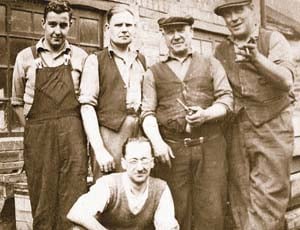
I am sending you the poem that gained me the runners-up prize for Forest Lauriate at the wonderful Forest Faddle in the Five Acres College Theatre in 2011. I have added a verse to update the poem to be relevant to the dispute over Northern Utd Colliery.
My grandfather, Jim Fox of Lower High Street, Cinderford, went to Northern United from Foxes Bridge Colliery (where he had started as a hod boy at the age of 13 in 1902) after it closed, and was present on that day on May 25, 1933, when the first sod was ceremonially cut by Miss Eliza Crawshay to sink the shaft and he worked there, firstly as the shaftsman, inspecting the 270 yards deep shaft on a daily basis, as well as the 70ft high headgear.
It was he, along with William Hale and Stanley Annetts, who climbed up the headgear with ladders and hoisted the Union flag on the day of Thursday, February 8, 1934 at 11am, when the first coal was struck.
It was a great day for Cinderford and the Forest of Dean, the new colliery would provide jobs for hundreds of men and boys for years to come, ending the depression that had stalked Forest households for a decade.
In the Gage Library archives at the Dean Heritage Centre, thanks to Maurice Bent, there are deposited the Northern's log books. These contain the names, tally check numbers, job descriptions and addresses of all the people who were ever employed at the colliery, below and above ground. Up to a thousand names and a fascinating and often emotional read for the many local people who have visited the library to research those relatives who left their 'blood on coal'.
Also, thanks to Maurice we have many artefacts from Northern and his book 'The Last Deep Pit of Dean', that is the most comprehensive history of a Forest of Dean Colliery ever published and a superb educational tool for present and future generations.
Jim Fox spent his last few years at the colliery in the relative calm of the carpenter's shop and retired at the age of 70 in 1960. His stories about his life "in the pits" still resonate within my spirit and the thought of the destruction of yet another site of iconic industrial Forest buildings that could be restored to lead a useful existence, leaves me cold with anger.
Yes, they are in bad shape; but TV is now awash with programmes that specialise in showing how the most derelict of buildings, from castles to cottages, can be lovingly restored by using modern technology, often by individuals who have no prior experience. Even Caroline Spellman now professes to be a huge advocate of restoration of the environment, including the 'built' one.
I was recently 'accused' at a tourist heritage meeting of being "too passionate" when I was, admittedly, very antagonistic towards a county councillor whose attitude I felt was patronising, smug and completely ignorant (perhaps deliberately) of the major role that Northern Utd has played in the history of the Forest of Dean. I must profess and I'm certainly not alone on this, that I'd rather be " too passionate" than base my feelings on the 'shifting sands of expediency' any time.
There is very little 'bricks and mortar' evidence left of the 2,000 years plus of our unique industrial heritage; so if the so-called 'regeneration board' must spend a fortune of our tax money on their new road to Oz, will they please get their pencils and rulers back out of the drawer and draw another line to once again go round the Northern site and thus in one stroke leave the old colliery and its rare inhabitants, the bats, well alone, as well as regaining some of the respect that they don't have now from those that care the most.
– John Belcher, Berry Hill.
---------
When we wuz yung
What times we 'ad
What games we ployed
As we raced zo brave
With 'eavin' chests
Dru Vorest glades
That sparkuld
In their verdunt green.
An' 'ow we laffed
In owr privut werld
Zo vibrunt green
As toime stood still
When we wuz yung.
But beneath owr vit
Var below zoft Vorest vloor
In oppressive dark
Zweat-wreathed men
Cursed an' tore
At gleamin' zeams
In 'umid 'eat
Ta win tha coal
That vuelled owr werld
O zun-villed larks
An' child 'ood ploy
When we wuz yung.
An' now we be owld
'ave we vergot
Them ruff 'ewn men
Oo vormed owr lives
In deep cruel mines?
Or be we wizer now
An' gi' thoy their due
Which we did not do
When we wuz yung.
But zoon I vear
Owr last deep mine
Will vall
Brought low by those
Wi no nous at all
An our yung volk
Will never knaw
'ow life wuz ployed
Abuv an' belaw
Dru Vorest glades
An dark-villed mines
When we wuz yung.
Comments
This article has no comments yet. Be the first to leave a comment.