

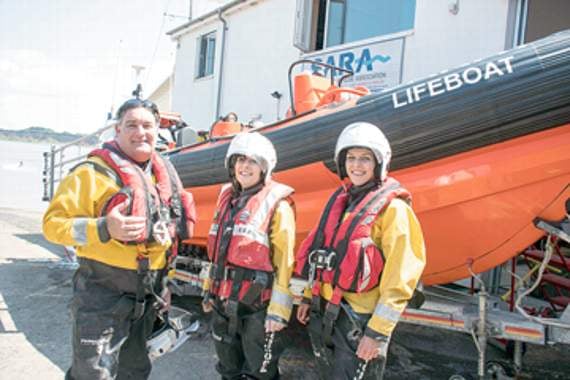
TWO supporters of rescue service SARA got a close-up view of how volunteers respond to emergencies.
Debra and Leigh Stiley rode SARA 1 from the Severn Area Rescue Association’s Beachley station to the Wye Bridge at Chepstow.
Leigh put in the highest bid for the experience at a charity auction at Hood Memorial Hall at Devauden near Chepstow and took mum Debra along.
She said: “It was about 18 months ago but it’s been worth the wait.



“It was an amazing experience although we had a nice, calm day with plenty of sunshine which helps.
“We’ve always had a lot of respect for what SARA does but this gives a bit more of an insight.”
“It was a bit of fun for us but we know how serious their job is and we appreciate it so much.
“SARA come along to our Bonfire Night at the hall and they also trained us when we had a defibrillator installed.”
At the helm of SARA1 was coxswain Ian Blayney who said the craft reached speeds of 43 knots, about 46mph.
The run to Chepstow took place during the Beachley station’s annual open day on Sunday.
SARA chairman Chris Crowley said: “The open day is an opportunity for the public to come along and see what we do.”
The open day was also supported by the Chepstow Coastguard, which is based near the Beachley station.
It is estimated that it costs £40,000 a year
to keep the life-saving Beachley station operational and most of that comes from public donations. Insurance and fuel are the two biggest expenses.
Mr Blayney said: “We did an emergency run down to Portishead and the M5 road bridge and burned about £80 worth of fuel getting down there, rescuing the casualty and getting back.”
SARA crew and the coastguard carried out a search of the River Severn from Aylburton towards Gloucester when an emergency beacon signal went off.
The emergency position radio indicating beacon (EPRIB) signal was detected at around 7.30pm on Tuesday of last week (June 13) by the National Maritime Operations Centre at Fareham in Hampshire which initially alerted the coastguard at Milford Haven to co-ordinate a rescue.
Signals from EPRIB are treated as an immediate threat to life and the search involved personnel from the coastguard at Chepstow, SARA and the coastguard helicopter from St Athan near Cardiff.
A sunken boat in Lydney Harbour was checked over but was not the source of the distress signal.
Distress beacons are tracked by orbiting satellites and the search was stopped when information was received that the signal was coming from the East Midlands.
A spokesman for Chepstow Coastguard said: “It was probably an accidental activation.”
People who buy distress beacons are encouraged to register the devices with the appropriate authority as registration includes giving contact details such as mobile phone numbers and radio call signs.
Comments
This article has no comments yet. Be the first to leave a comment.