
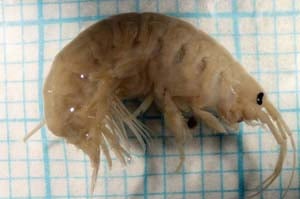
THE Environment Agency is on full alert after relative of the so-called 'killer shrimp' was found in the River Severn at Tewkesbury.
The invasive shrimp, Dikerogammarus haemobaphes, related to 'killer shrimp' Dikerogammarus villosus, has also been found on two canals in Worcestershire.
"This is the first time this non-native shrimp, which has been shown to be invasive on mainland Europe, has been found in this country," said an Agency spokesman.
The shrimp was found after samples were taken from the River Severn for Severn Trent Water. Experts were then able to conclusively identify the species as Dikerogammarus haemobaphes.




Shortly after, other populations were discovered on the Staffordshire and Worcestershire Canal and the Worcester and Birmingham Canal. The sites are spread over a distance of approximately 38 kilometres.
"While this new invasive shrimp species is related to the 'killer shrimp', we are uncertain at this stage what its impact might be," said the spokesman.
"Until we have better information we will, as a precaution, treat it as a high impact species. An immediate assessment of the risks of this shrimp has been commissioned."
The Environment Agency and the Canal and River Trust are urging all water users to help slow the spread of this invasive species by helping publicise the bio-security advice available at http://www.nonnativespecies.org/checkcleandry">www.nonnativespecies.org/checkcleandry
If you think you have seen an unusual shrimp, please email a photograph to alert_nonnative
@ceh.ac.uk for identification.
Dikerogammarus villosus was first spotted by anglers at the Grafham Water reservoir in Cambridgeshire and sent to the Environment Agency for identification.
The shrimp preys on a range of native species, such as freshwater invertebrates, particularly native shrimp, and even young fish.
This alters the ecology of habitats it invades, and could cause extinctions.
According to the Environment Agency it often kills its prey and leaves it uneaten.
Insects such as damselflies and water boatmen could be at risk, with knock-on effects on the species which feed on them.
D. villosus has spread across most of Western Europe over the last 10 years. It can be as small as 3mm but may grow up to 30mm long, making it much larger than native freshwater shrimp.
Comments
This article has no comments yet. Be the first to leave a comment.