
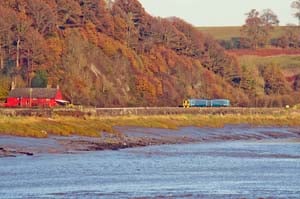
RAIL passengers using Severnside stations are on the 'Cinderella' line – and paying higher fares for the privilege.
Fares for Arriva Trains Wales services from Lydney, Chepstow, and Caldicot are substantially higher than the Welsh Valleys despite the line missing out on improvements by the company.
Rail campaigners have dubbed the line – which has seen a 131 per cent increase in passengers in a decade – the Cinderella line.
Mr Phil Inskipp, who is also a member of the Railfutures group, said: "It has acquired the name because despite the growth on the line outshining all the other Cardiff suburban lines it has been overlooked for improvements."



Mr Inskipp and fellow campaigner Colin James have written a paper for the Institute of Welsh Affairs outlining how the line has been largely overlooked since privatisation 20 years ago.
According to the paper the cost of an anytime day return from Chepstow to Cardiff is £4.60 more – at £12.40 – than the same ticket from Ebbw Vale despite the Monmouthshire station being just half a mile further away from the Welsh capital.
Mr Inskipp said: "All the other Valley Lines benefit from the Welsh government's subsidised and considerably lower fares with the annual season ticket from Chepstow to Cardiff costing twice that of all the other lines."
Mr Inskipp and Mr James said that the Welsh government was given responsibility for overseeing the Arriva franchise in 2002 with the assumption there would be no growth in use over the life of the franchise until 2018.
"All the other Valley Line services have benefited from increased service levels under the Welsh government's management.
"The Merthyr line now has 27 more trains a day; by comparison Arriva Trains Wales have actually reduced their services on the Cinderella line by two."
Under nationalised British Rail (BR) there had historically been 14 trains a day in each direction on the line and at privatisation the government insisted on a minimum of 12.
There were 13 daily until 2009 when "to save costs they (Arriva) reduced the service to the contractual minimum level originally intended as a 'safeguard'," said Mr Inskipp.
It had been hoped that by this year there would at last be a half-hourly service on the lines but there are still gaps of more than an hour for travellers between the Monmouthshire stations and Lydney.
At Caldicot there are gaps in the timetable of up to two hours and 21 minutes between trains headed for Cardiff, said Mr Inskipp.
He added: "This is a long way from the average one train an hour and BR's proposal to increase this to two trains an hour."
The line will be the only one left operating diesel units – that will be up to 30-years-old – when routes into Cardiff are electrified by the end of the decade.
Railfutures say the only improvement made by Arriva is the extension of services to Cheltenham.
An Arriva Trains Wales spokesperson said: We operate services to meet the passenger service requirement as defined in the Wales and Borders franchise contract. Additional services are operated where there is sufficient demand to make it commercially viable and the resources are available to operate them including fleet availability – we only have finite train resources available to us and we are currently fully stretched and track capacity provided by Network Rail.
"Welsh Government has specified and funded improvements on the rail network in Wales. such as Merthyr and Fishguard. As for electrification of the line – this is a government decision rather than that of a train operating company.
"As for the price of season tickets, historically there have been some pricing discrepancies across the network due to the inheritance of different company pricing structures when the franchise was put together.
"Valleys Line season tickets have historically been lower than other comparable routes.
"However, Chepstow to Cardiff season tickets fares still offer good value especially if you make comparisons with season ticket fares for similar journeys into other major cities."
Comments
This article has no comments yet. Be the first to leave a comment.