

RESIDENTS who oppose a new plan for 200 more homes say their town is at “breaking point” and the scheme will “cripple” it.
Residents who object to Barratt Homes’ outline scheme say the town is already at “full capacity”, with the axing of the Severn Bridge tolls set to make things worse.
The scheme’s submission comes amid new calls for a £100m bypass around the town to ease congestion and pollution, with no less than 3,200 new homes pencilled in for the Chepstow and Severnside areas in Monmouthshire, and Lydney over the border.




Barratt Homes has submitted the outline plan to develop a “sustainable new community” on three fields on the edge of the town beside the Wye Valley AONB.
With approval granted in 2017 by Monmouthshire Council for the development of up to 450 homes on Chepstow’s former Mabey Bridge site, coupled with hundreds more approved in south Gloucestershire, residents fear the latest plans will “cripple” Chepstow, which is already one of the most polluted places in Britain.
With the M48 passing nearby, air pollution exceeds limits set by the World Health Organisation, prompting calls for a bypass to ease traffic congestion on the A48 at Hardwick Hill and A466 High Beech roundabout.
Shaun Hartley of the Bayfield Residents’ Association said: “It is clear that Chepstow has neither the resources nor the infrastructure to support the proposed Bayfields development, particularly in the context of the circa 1,000 houses already approved for development in the town.
“The local primary school, doctors and dentists are all at capacity and Chepstow is at breaking point with regard to traffic congestion.
“Yet this development, on the fringe of town, would encourage at least 200 extra cars onto the roads and will bring further pollution to a town that is on record as suffering from some of the most polluted air in Wales.
“No-one truly knows what impact the removal of the M4/M48 bridge tolls will have but as locals we are facing government-projected traffic growth of up to 60 per cent, a good portion of which will flow via Chepstow as it connects with Gloucestershire and the Wye Valley.”
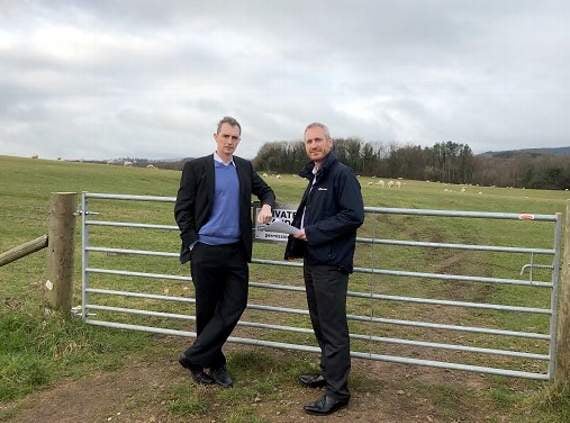
On a visit to the proposed housing site, Mr Davies said: “We certainly need to look at ways of getting more money out of developers to tackle these infrastructure challenges when large numbers of people move into a small town which is already full.
“The Welsh Government is prevaricating over the need for a bypass around Chepstow which would solve some of the traffic and pollution problems, but we cannot realistically see this happening for a number of years.
“I fully understand the need for new housing, but would have thought it might be better to build on more sustainable brownfield land in the Severnside area between Newport and Chepstow with access to either the M4 or M48.”
Meanwhile, Monmouthshire councillors discussed a new transport study last week which put forward a £100m bypass as a potential solution to congestion and pollution in the town.
A new motorway junction and improved rail services were also suggested in the report, jontly commissioned by Monmouthshire and Gloucestershire councils.
The study said congestion was “hampering the future growth and development” of the Chepstow area, with A48 traffic predicted to rise by 31 per cent by 2024 in the wake of the toll scrapping.
Monmouthshire council leader Cllr Peter Fox (Con, Portskewett) said the town was facing a “perfect storm” of increased pressure on its roads, and while funding was a huge issue, he urged the Welsh and UK governments to “step up” and find a solution.
Bypass campaign group founder Cllr Jezz Becker (Lib Dem, St Mary’s Chepstow) said the study supported “everything we’ve been talking about for years.”
Comments
This article has no comments yet. Be the first to leave a comment.