
MORE evidence of Monmouth's historic past has been discovered during the gas mains replacement in the town.
Excavations throughout the top of the town have revealed much of the town's Roman heritage while work in Granville Street and Wyebridge Street have also exposed the foundations and cellars of some of the houses that were destroyed to make way for the dual carriageway in the 1960s.
Local archaeologists, who have been examining the trenches made around the streets of this historic town, were able to extend some of the excavations in Almshouse Street to a depth of two metres, but even they failed to reach the bottom of the Roman levels.
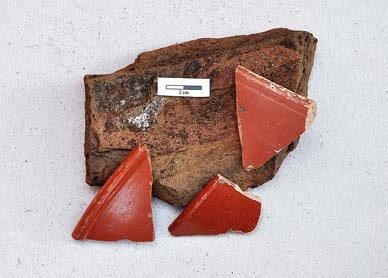
The Roman period was richly represented by a wealth of finds including pottery and decayed bone.

There were also examples of industrial activity with the presence of iron working, matching the finds in St John's Street and Glendower Street earlier in the year.
More of Monmouth's mediaeval history was also uncovered with a 14th century road surface discovered at around a metre below the modern Almshouse Street. This road was found to have sealed Roman and earlier mediaeval remains including a cess pit.
The Roman pottery from Almshouse Street included 1st and 2nd Century Samian Ware made in different parts of Gaul (modern-day France) together with vessels made locally in the Severn Valley area during the First Century AD.
The construction of the town's earliest known roads were found in the two streets as much as 1.5 metres below the modern surface with iron slag from the Roman and mediaeval furnaces being one of the main construction materials.
Stephen Clarke, chairman of the Monmouth Archeaolgical Society, said: "Whilst these finds are wonderful examples of life some 2,000 years ago we have had to enlist the help of specialists to help us understand the context and content of some of the other remarkable finds that have been unearthed here in Monmouth."
Comments
This article has no comments yet. Be the first to leave a comment.