
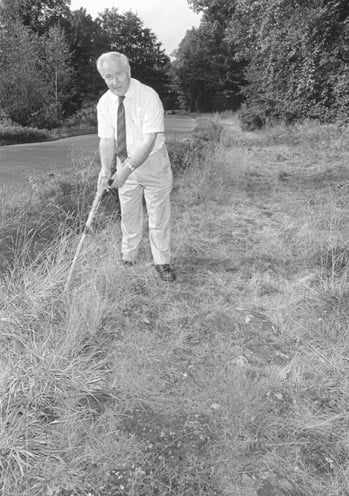
LOCAL historian Brian Johns has cast new doubt on the origins of the famous so-called Roman Road at Blackpool Bridge near Blakeney – he's now certain it wasn't built by the Romans!
Mr Johns, who has spent a lifetime researching the history of the area, doesn't doubt Romans might have used parts of the route, probably started in neolithic times and part of a tracery of paths in the Forest.
But he doesn't think the popularly held view that it was built and maintained by the Romans can any longer be supported. And it certainly wasn't a major route for them.
"Research shows the Romans built raised roads, but the section at Blackpool Bridge is sunken," he said. "Some say this might be because of repairs – but all I can say is there must be an awful lot of repairs.



Artifacts
"The Romans also favoured taking their roads over high land and ridges, giving them visibility, while this route runs through gullies."
While Roman artifacts have been found near the road, so have relics of other ages dating right back to palaeolithic times. "Since time out of mind I think the expression is, " he said.
The popular view is that the road, which runs in total from Highfield Hill at Lydney to Mitcheldean, was constructed by the Romans to transport iron ore for shipment from Lydney.
"The route lies along the outer edge of iron ore deposits. The argument for the Romans is that they needed to cart charcoal and ore along it to their smelters," said Mr Johns. "But there is evidence to show that ore was in many cases smelted on the spot, with the ore brought to the charcoal – it's a question of one bag of ore to four of charcoal. It makes more sense this way round.
"The road is also too narrow to be a commercial route. It's only nine feet wide, which can just accommodate a cart. Anything coming the other way would have to move aside."
Reason
He believes there might have been another, later reason for establishing the paved road – millstones.
"Many people overlook the fact that the millstone outcrop is along the same route. They were fashioned and then taken to the river to be shipped. The trade died when millers began using imported stones and also segmented stones bound by iron hoops – making repairs easy – came into use."
If it isn't a Roman road – and Mr Johns' view is certain to reawaken controversy on its origins – the question of who did take the trouble to lay the cobbled surface is raised yet again.