
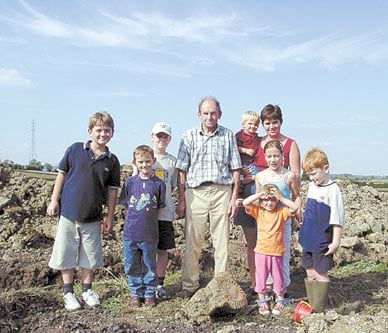
EAGLE-eyed John Trenchard, called in to dig a trench for farmer Ernest Awre, spotted a strange rock when his digger bucket ripped through topsoil into grey clay.
Quick-thinking John stopped his machine and clambered down to examine the rock only to discover an enormous fossil ammonite several millions of years old.
"I think he did very well to spot it in all that mud," said Ernest, of Guy Hall Farm, Awre, which overlooks the River Severn.
"Now we are going to keep our eyes skinned for more as the rest is being dug, and the other rocks when it is filled in again."


The coiled ribbed shell of the sea creature, which floated along in pre-historic sea currents and had octopus-like tentacles, is about eighteen inches across.
Washing it has revealed an intricate pattern of leaf-like markings on its sides and other markings on the rim.
"Although I know it can't be they look just like numbers," said Mr Awre, who was so excited he called the Dean Heritage Museum to come along and have a look at it.
As a result the museum has asked Mr Awre if they can borrow it for a forthcoming exhibition about the River Severn.
Finding the shell has opened up a new interest for Mr Awre and his sons, who had a big suckler herd and some sheep destroyed in the foot and mouth epidemic – the trench is being dug to bury the remains of a pyre.
"We have been told we can restock in October, but we lost years and years spent building up the herd," he said.
"I have two sons and their families relying on the work and no income at the moment. It can be very upsetting at times."