

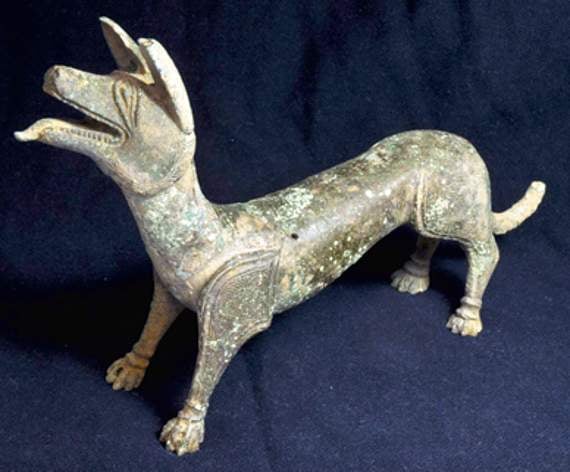
THE 1,700-year-old licking dog is a ‘healing statue’ and experts think it may be linked to the Roman temple at Lydney or that there could be a previously undiscovered temple elsewhere in the county.
Archaeologists believe the items may have been stashed by a metal worker who intended to retrieve them to melt and recast.
Many of the artefacts appear to have been deliberately broken but the dog remains intact.
Pete Cresswell and his brother-in-law Andrew Boughton, who made the find, described it as “a once-in-a-lifetime” discovery.”



The artefacts are of such significance that they are being kept in special conditions at a museum in Bristol.
Experts are piecing together the clues and the findings will be launched at the British Museum in London, probably at the end of the year.
Mr Cresswell said: “It’s not every day you come across a hoard of Roman bronze.
“We have been metal detecting for a combined 40 years, but this is a once in a lifetime discovery.
“As soon as I realised the items were of historical significance I contacted the local archaeology team, who were equally excited by the find.
“It’s a great privilege to be able to contribute to local and British history.”
Archaeologist Kurt Adams, Gloucestershire and Avon Finds Liaison Officer, said: “This Roman hoard dates to the fourth century and mostly contains items that have been deliberately broken, ranging from small vessel fittings to a large bronze statue.
“Most amazing of all is a complete and finely detailed standing dog statue, which is a unique find for British archaeology.”
Gloucestershire County Council’s Cabinet member for fire, planning and infrastructure, Cllr Nigel Moor (Con, Stow-on-the-Wold) said: “How wonderful to have made such an astonishing discovery, and what a fantastic coup for Gloucestershire.
“The prospect of more hidden treasures buried here in the county is an exciting one indeed for local residents and historians alike.
“Congratulations to Pete Cresswell on making this find and fitting another piece into the jigsaw puzzle of Gloucestershire’s rich heritage.”
---
What’s in the hoard?
THE HOARD includes more than 100 individual items including a coin minted in Germany between AD321 and AD324 during the reign of Constantine the Great, pieces of a statue that would have stood some three to four feet tall and a lion’s head escutcheon similar to one found previously at Lydney.
The full list of items is:
• Licking dog statue, 214mm long 134mm high 50mm wide
• Twenty fragments from large hollow cast bronze statue that would have stood about 3ft to 4ft tall
• A 12-sided fragment
• Folding frying pan handle fragment from the third of fourth century
• A face with curly hair, possibly from a vessel
• Face of a figurine
• An animal paw, probably the foot from a chest or box
• Two fragments of a thick copper alloy box.
• Bull’s head escutcheon
• Lion’s head escutcheon or mount, the same as an example from Lydney temple
• Human head escutcheon or mount
• Circular escutcheon with notches around the circumference
• Four fragments of an inscribed plaque reading (V?)MCONIA
• Possible vessel handle terminal.
• A twisted wire bracelet fragment
• A possible tweezers fragment
• Four chest/box handles which are different enough to surmise they are from four different vessels.
• One furniture fragment of a leg and foot of a vessel.
• A 4th century D-shaped buckle with decorated sheet copper alloy plate
• Three domed sheet copper alloy items
• Two fragments of a bracelet.
• A egg-shaped foot furniture fitting
• Ten bell-shaped casket decoration mounts.
• Twenty five cup or bell shaped furniture studs.
• One disc shaped furniture fitting with raised rim.
• Sheet copper alloy vessel, box and furniture fragments folded to reduce their size
• A hinge
• Four fragments of copper alloy slag, total weight 64.06g
• A coin dated to AD 321-324 minted in Trier, Germany
• A spoon
Comments
This article has no comments yet. Be the first to leave a comment.