
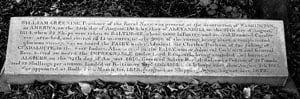
MORE secrets behind an already revealing tombstone in Newnham churchyard have been uncovered by a family researcher delving into his ancestry.
And while it was widely assumed William Greening had been a sailor, present-day relative Michael Greening knows otherwise – he was in fact a private soldier serving as a Royal Marine during the Bombardment of Algiers in 1816 which put paid to the white slave trade of the Barbary Pirates.
And earlier, he'd taken part in the historic burning down of the White House in the war against the United States: David Cameron recently apologised to President Obama for the incident!
-----------


Michael Greening maps out the extraordinary life of one of his ancestors, instrumental in the naval battle which stopped the Barbary white slave trade...
MANY of us like to wander around old churchyards and read the inscriptions on the tombstones. They can be of special interest to those of us fascinated with local history or the chronicles of our own families.
A few years ago an article in the Review told the story of what is possibly the strangest small tomb in Gloucestershire; that of a William Greening at Newnham. If you have not yet come across it, it is well worth a visit.
Much of the article was taken from my book A Family Story, which includes the lives of some of my ancestors who lived in the area of the lower Wye and Severn, but it diverged from my research with some incorrect information about William. I would like to put this right here for local historians and posterity.
Unlike other tombstones, William's gives a full biography of his life. It is said that he not only commissioned it himself but sat in the stonemason's yard to oversee its production. I speculate in my book that the exemplary carving was probably carried out by Frederick Hopkins of Newnham. The article suggested that William may have been press-ganged into the Navy, as many sailors were at that time, but must have risen to a high non-commissioned rank as he received a large pension.
This is not true, as William was never ever a sailor and remained a private soldier throughout his military service. William was a Royal Marine and his date of 'Attestation' was April 8, 1812. All marines were volunteers and they received a higher wage than sailors.
His record shows that he was five feet, four and three quarter inches tall, had brown hair, hazel eyes and a fresh complexion. He came from 'Lidney, Gloster' where he had been a labourer. He was discharged on 15 November 1816 as he had been 'Burnt & Wounded in Action'. His injuries were received when serving on the Impregnable, the second largest and most heavily damaged British Man-of-War at the Bombardment of Algiers on August 27, 1816. This was the battle that ended the white slave trade of the Barbary Pirates, which had gone on for hundreds of years.
As a marine, William had earlier been involved in the war against the United States and had taken part in the burning down of the original White House (Mr Cameron apologised for this during his recent visit to President Obama in Washington). He also participated in the seizing of the Caribbean island of Guadeloupe from the French in 1815.
William drew his military pension for many years, as he was discharged at the age of 25 and went on to live until he was nearly 92.
This was twenty pounds and twelve shillings annually and it does seem high for a private soldier, especially as he could not have been disabled. He married, had four children, and for nearly 55 years held the post of shipping agent at the tiny Severn port of Bullo Pill. I can only presume his pension was awarded because he was wounded in the service of his country, in a history changing battle greeted with jubilation throughout Europe.
Details of 'A Family Story' can be found on my website – www. michaelgreening.com
Comments
This article has no comments yet. Be the first to leave a comment.