

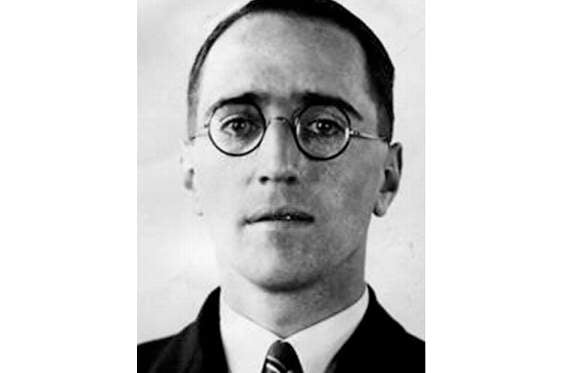
AN educational talk and walk led by a forensic scientist will examine Britain’s worst military test flight disaster, which killed some of the country’s top scientists.
The talk takes place near the Wyeside crash site at Goodrich Village Hall on Sunday, March 31, followed by a short walk to where the plane came down on June 7, 1942, below Coppett Hill on the Courtfield esate.
World renowned radar and sound expert Alan Dower Blumlein was one of six boffins who perished when the Halifax ‘flying laboratory’ burst into flames and plummeted to earth near English Bicknor at 4.15pm.
Their work was key in securing an Allied victory over Nazi Germany, but was overlooked for decades after Winston Churchill ordered news of the disaster to be hushed up.



The story is now finally being told, with a £5,000 online appeal launched last November for a permament riverside memorial to Blumlein and the other 10 who died.
And the event later this month will commemorate the shocking moment the plane came down, in a major blow for Britain’s secret wartime radar programme.
The sacrifice of the six scientists and five crew is remembered by a memorial stained glass window installed at Goodrich Castle chapel on the 50th anniversary, which people attending the talk can visit beforehand.
Forensic scientist Dave Scaysbrook will lead the talk and walk, which is due to be attended by Alan Blumlein’s son, Simon, who was six at the time of his father’s death.
The death of Blumlein robbed the Allies of a driving force in the top secret development of airborne radar. The scientists and five crew had taken off from RAF Defford near Worcester on the converted Halifax bomber, but perished on the return journey from south Wales when the aircraft caught fire over the Forest of Dean.
Bernard Lovell, who was later knighted for his work founding and running Jodrell Bank Observatory, had flown on the plane the day before and reputedly gave up his seat on the fatal flight.
But 38-year-old Blumlein – who included the invention of stereo sound recording among his achievements and was posthumously honoured with a Grammy award in 2017 – died alongside close colleagues Cecil Oswald Browne and Frank Blythen in the UK’s worst ever military test flight tragedy.
The crash scene was quickly sealed off by military guards while a team led by Lovell recovered the highly-secret cavity magnetron the plane had been carrying.
Seventy seven years on, thousands of walkers pass the spot on the Wye Valley Walk without realising its tragic significance.
But that could all be about to change, after walks writer Garth Lawson launched a £5,000 appeal to put up a memorial to a man who did much to help the Allies win the war.
Alan Blumlein’s grandson, also called Alan, said: “He was one of the greatest electronics engineers ever to have lived, contributing not just to the world of audio but to early telecommunications, the television system adopted by the BBC in 1936 and, during World War II, in the development of the crucial H2S Airborne Radar system that contributed greatly to Britain winning the war.”
In 2017, 75 years after his death, the Recording Academy presented the scientist’s family with a posthumous Technical Grammy in New York.
Mr Lawson said: “While the contributions of other Second World War boffins such as Alan Turing, who helped crack the Nazis’ Enigma code, and radar pioneer Bernard Lovell have been lauded, Blumlein’s role has been largely overlooked.
“We plan a permanent memorial to Blumlein and his colleagues, in the form of a metal plaque mounted on a plinth near a riverside path overlooking the site of the tragedy.”
For tickets to the talk, go to www.ticketsource.co.uk and search for ‘Goodrich Halifax’. The visit to the stained glass window takes place at 9.30am, followed by the talk at 11am.
To support the riverside memorial appeal, go to www.justgiving.com/crowdfunding/glawson
Comments
This article has no comments yet. Be the first to leave a comment.