
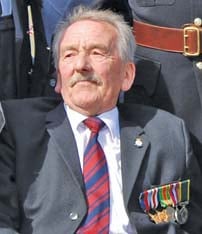
Eric was born in Manchester to Maria and Fred Dawson on March 19, 1920, the middle child of five. He attended the local elementary school.
His family life through the late 1920s and mid 1930s, in common with many others through this time of great economic depression, was poor and hard pressed. At 14 he walked past queues of men to be a cheaply employed painting and decorating boy, mixing paints from powder and making tea on vast mushrooming estates of new build properties in mid 1930s Manchester.
Luckily, his combination of hard work, practical skills with his hands and artistic flair (demonstrated by his many huge charcoal drawings of scenes from King Kong on yet to be painted interior new house walls), was recognised by representatives of a prestigious church decorating firm, Bells.
He was given an apprenticeship incorporating training at Salford Technical College where his sign writing career started.

.jpeg?width=209&height=140&crop=209:145,smart&quality=75)

But Eric put all that on hold though when, in 1938, he stepped down from the ladder on the Jaeger shop front sign in central Manchester and leaving overalls behind, joined the Royal Engineers Forestry Company.
Arriving in The Forest by train this young sapper, having walked from Cinderford along Church Rd on March 19, 1941, bought a bottle of Guinness at the Red House Off Licence and a lump of cheese. Eating this simple food, sitting down alone in the Drill Hall at the White Hart in St White's Road was in fact how he celebrated his 21st birthday.
It was while on that walk into the Forest that he first heard, 'Ow bist Old Butt.'
He met and married the Forest girl, Maud Worgan, a young teacher from Ruspidge, Cinderford, while his Company was stationed there. This was the beginning of his lifelong love, not only of Maud, but also for the Forest about which he wrote prolifically in his poems over the next 70 years.
In complete contrast to his army life, newly married, he settled into gardening and even won a prize for his potatoes in the Ruspidge Horticultural Show. He joined the St John's Cricket Club and when his company left for France they were given a club cricket set to take with them. Shortly after D-day Eric's company landed on a Normandy beach. But it was when his company was about to cross the Rhine that they were unfortunately ordered to bury the cricket kit, along with all extraneous items, in a slit trench.
He survived the campaign, moving through France, Holland and Germany; he was hospitably received by a Dutch family and was billeted with them for months. Here Eric shared his rations and in exchange for chocolate once made his own sign writing brushes with the young blonde Dutch children's hair.
In Germany he survived bullets being fired through the floor and was saved from drowning in the Rhine, by a very kind Italian prisoner.
Eventually returning home in 1946, Eric's duties had included those of shoe mending, cooking for the whole company on a moving train, helping in the quarter master's stores and of course sign writing in many scripts and languages. He was the best shot amongst his fellow soldiers and as a penalty had the Bren-gun to carry.
De-mobbed and a father of two girls, Eric became a foreman with Giles, the local building firm until he eventually set up his own business, inspired in part and mentored by Cinderford's previous skilled sign writer, Charlie Parry of Station Street.
Eric took his business responsibilities very seriously and left behind a legacy of prestigious work in various decorating techniques including graining. His high standards, not only in the trade and among those who trusted and admired his work, but also in his care for those boys that were employed by him from Double View Secondary School, made him a popular employer. In the town of Cinderford he was always known as Eric and his membership of the Chamber of Trade included a spell as Chairman.
In the early 1950s he developed a strong interest in acting and was an enthusiastic member of the Mintec Players, often playing older grey haired men. It was during this time, working for Captain M. G. Corbet-Singleton, at Littledean Hall that Eric, whilst decorating a ceiling, came across a secret trapdoor. Hidden in the cavity above he had found a container of the family treasures. The family naturally was very grateful but the story, once heard by the Forest playwright Harry Beddington, was the seed for a new play written by Harry in which Eric performed at Mintec, the drama company based at East Dean Grammar School.
Eventually by 1963, the family had saved enough to move to a new bungalow and he and his family of three children, began to embrace the modern and prosperous 60s life that came with it. Another skill learnt through his church decorating work was the art of gilding. This held him in great stead and lead to much work on clock faces on many churches in the Forest. In those pre Health and Safety days he worked on a ladder with nothing more behind him, he used to say, but Europe.
Gilding was something he loved and there was something magical watching gold leaf attaching itself to the surfaces he prepared. Fleets of well known transport coaches and quarry lorries were lettered by Eric besides business vans, house signs, advertising hoardings and names on Masonic, church and school boards.
Eric's business expanded but change came with a new bout of unemployment and recession in the late 70s and the business eventually folded.
Eric and his wife then began a successful eight year buying and selling enterprise, with market stalls in Tewkesbury, Cinderford and Cheltenham, going to house sales and auctions. He continued to utilize his skills of wood treatments and finishes on the variety of items they bought.
During this period of his life, although he continued to write poetry he had never been published. He did however enter the Cheltenham festival and read aloud a selection one year. Eric had become friends with the poet, Harvey and had on occasion taken his poems to critically share with him at his home. Always brimming with ideas and opinions he then began a series of letters to universities and influential scientists.
Retirement finally arrived with a move to English Bicknor in1988, Eric enjoyed the companionship, friendship and stimulation of Probus membership with other retired businessmen; this included a period as chairman. Despite by now suffering from extreme arthritis in his hands, he lettered the St Mary's Church notice board, climbed ladders into the roof and advised the PCC on the fabric of the church. Both Eric and Maud offered each other mutual companionship and were a great support to St Mary's, where they were strong contributors to the Parochial Church Council hosting meetings at their home into their early nineties.
It was whilst in Bicknor, over the next 20 years, that Eric developed great friendships with other war veterans; sharing stories about war experiences. Sadly, in February 2009, Eric suffered a serious stroke and was hospitalized for eight weeks. By now wheelchair bound but undaunted, he made a valiant effort when asked to attend (as a VIP), the celebration in Coleford when 1 Rifles were given the Freedom of the Forest. He insisted that he shook the hand of every one of those soldiers who had just returned from Afghanistan as he was wheeled past their line. He was humbled and proud to receive his Veteran's medal from The Queen and various other medals from the French Government for services during the Second World War.
After his move, with Maud, to live with and near his daughters in Surrey, he continued to show compassion and empathy for others. Using his elocution, acting skills and his great interest in anything artistic, including poetry and literature, he helped his fellow stroke recoverers especially with speech training at the Guildford TALK group; leaving a lasting impression. His interest and previous training in heraldry and gilding had served him well throughout his working life when, at over 91 years of age, he was to be given a final opportunity by Peter Hands, the proprietor of the Speech House. Eric stayed there when he had travelled to the Forest for the funeral of his wife Maud in March 2011. He was invited by Peter to advise on the care, restoration and cleaning of the two Coats of Arms rescued by him from the local magistrates court (Coleford).
His somewhat poor start in life had created within him a huge resourcefulness which sustained him through the war years and subsequent tough times setting up a small business in the 1950s. Sustaining Eric throughout was his ability to take evasive action in adversity (honed during the war). His gregariousness, inventiveness, optimism, lateral thinking and his ability to retain good relationships were unique as was the ability to win people over without a hint of aggression. Most of all his love of and his ability to write creative poetry were a delight.
He bore his ever debilitating illnesses with stoic determination to the end of his life, with never a hint of bitterness or regret. He died on Monday October 3 very peacefully with a wry smile on his face, having been married to Maud for almost 70 years.
Principally Eric was a family centered man, a great dad, devoted to his wife, three children, eight grandchildren and eight great grandchildren.
At over 91 when asked about his life he said:
"I was a boy that just, grew and grew.
Discovery was something I have always liked.
My own children... what I enjoyed the most... treasures.
Even when I have died I think in some ways I will be living forever."
As his coffin was lowered into his grave the sun momentarily shone over the hedge as the clouds parted, one could have almost heard him whisper, 'Magic! Fantastic!'
May his soul now, 'Rest in Peace'.
Comments
This article has no comments yet. Be the first to leave a comment.