

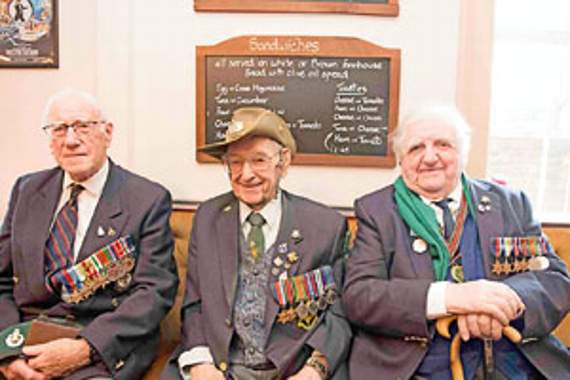
A SECOND World War veteran was presented with France’s highest honour in recognition of his part in the liberation of the country in a ceremony in Lydney.
Peter Terndrup was presented with the Legion d’Honneur by the French Honorary Consul in Bristol, Josette Lebrat.


She said Terndrup’s investiture as a Chevelier de la Legion d’Honneur – Knight of the Legion of Honour – also remembered those who made the ultimate sacrifice.
Among those at the Watney Hall were members of Mr Terndrup’s family, friends and Second World Veterans.
Mme Lebrat told them the Legion d’Honneur was France’s highest decoration and that in 2014, on the 70th anniversary of D-Day, French president Francois Hollande had sent a strong message of gratitude to the Allied soldiers, particularly the British.
She said: “Today it is a true honour for me to confirm and echo that message.
“Mr Peter Terndrup you are a living witness to a history you wrote on our soil, a history that shaped your identity, our identity and those of Britain and France.
“What a great example you present for me, for young people, for our respective countries and for Europe.
“Today you are made Chevilier de la Legion d’Honneur. You are a hero of the Second World War.
“Today we also remember your friends who did not make it back.
“Through you, and through this ceremony, we honour their sacrifice and courage.
It is through the courage of men like you that our parents across the Channel were able to regain their freedom.
“On behalf of the French Republic and our parents I would like to say a warm thank you.”
Mr Terndrup, who is now 92, enlisted at Southampton on his 16th birthday and was sent to the Army Apprentices College at Beachley to learn to become a fitter.
He said: On my 16th birthday I enlisted at Southampton as an apprentice fitter and turned up at Beachley army training school.
“I wasn’t particularly good at being an apprentice fitter so after about two years I got my mother to support my application to transfer to the Armoured Corps and was posted to the 13/18th Royal Hussars.”
His training as a tank driver included learning to get out of a tank with submarine escape apparatus – which became especially useful on D-Day, the start of the Allied liberation of Europe.
He said: “My tank sank – It’s difficult to imagine a 30-ton tank going two miles from the landing craft and getting within spitting distance of the beach but that’s when it went down.
He found himself back where he had started, in the Hampshire port of Gosport, but within three weeks he was back in France.
“I had a week in the hospital to make sure I was mentally fit and I was back in France with the regiment within about three weeks.
“From there we went through France into Brussels then touched parts of Germany and had all the battles that ensued.”
At Arnhem in Holland, the tanks’ advance was halted by the river but Mr Terndrup remembers taking shots at a tall chimney that was being used as an observation tower.
They eventually crossed the Rhine and were planning an attack on Bremerhaven when the news came through that the war was over.
He successfully applied to become an officer and was posted to Berlin with 1 Tank Regiment where “World War Three nearly broke out.”
He said: “The officer commanding the squadron had his jeep pinched by the Russians and he was lining the tanks ready to go and rescue the jeep. Fortunately he was stopped.”
After the war Mr Terndrup had several stints in the army, including a posting to Egypt during the Suez Crisis of 1956.
He eventually got a job through the Officers’ Association at the Bank of England it was while working in London he met his future wife, Gwyneth, who was the daughter of Tom Thomas who owned the quarry at Tidenham.
He got a job with Mr Thomas and the couple moved to Lydney where Mr Terndrup still lives.
Of the honour he said: “It is quite an honour and reflects what we had done for the French.We knew what the risks were and we did it quite happily.”
Comments
This article has no comments yet. Be the first to leave a comment.