

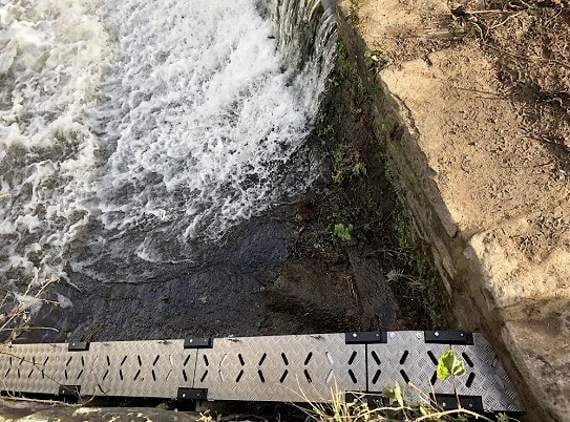
AN ancient and protected fish and a critically endangered eel have been given a big boost with a new weir pass to reach spawning grounds.
Blackpool Brook in Blakeney is an important habitat for migrating fish and eels, but there are no recent records of the ancient lamprey being seen upstream of the village weir.
But it is now hoped that a new pass will help both lamprey and the European eel travel upriver to spawn.
The jawless lamprey evolved almost 200 million years before the dinosaurs and has been dubbed a ‘living fossil’.



It was a staple part of many Foresters’ diets before the Industrial Revolution but numbers dwindled in the 19th and 20th centuries and efforts are under way to help it reclaim its traditional river habitat.
The new weir pass has been jointly funded by the Environment Agency (EA), Foresters’ Forest – the Heritage Lottery-Funded Landscape Partnership Programme in the Forest of Dean – Natural England and Awre Parish Council.
Chris Bainger, EA Fisheries technical specialist, said: “This is an exciting example of local partnership working and investment to help create a better place for two species of fish whose populations are in widespread decline, the European eel and river lamprey.
“We hope this is the start of something special to engage the local community and raise awareness to help return these two iconic species to sustainable levels here in Gloucestershire.
“Both the eel and lamprey undertake complex migrations and each depend upon open access from our oceans and rivers to reach their destinations to complete their lifecycles. The weir in Blakeney has blocked one of those pathways and has been a barrier to upstream migration.
“Worldwide we are starting to realise the very significant threat and impact that barriers to migration have on our fish populations. When fish cannot reach their habitat, they can’t reproduce and rebuild their populations.
“This pass should significantly help both the eel and river lamprey gain access to and thrive in the rich water environment of the Forest of Dean.
“Both these fish had a rich cultural heritage and history in supporting the people of the forest before the time of the Industrial Revolution. Eels and lampreys were so numerous they were an important food source and supported the local economy as a delicacy that was distributed throughout the country, including to the Royal Courts.
“It is now our time to help eel and lamprey gain access to the Forest once again. This fish pass project as part of the Foresters’ Forest programme should go some way to help restore those populations to those historic levels.”
The pass is part of the Foresters’ Forest Waterways and Ponds project (FFWPP), which aims to help restore ecological connectivity across the Forest and encourage the recovery of iconic species that rely on water.
Alisa Swanson from Natural England and leader of FFWPP, said:
“Eel and lamprey may not be the most attractive fish to look at, but they are an important part of the ecosystem and a species which has had a long-held association with the area.”
“We hope that the new pass at Blakeney is an important first step in helping them expand their habitat here in the Forest of Dean.”
Later this year, Bournemouth University will be carrying out a series of lamprey surveys across the Dean to establish the status of lamprey populations.
There will also be opportunities for volunteers to help with monitoring and looking after the eel pass and then in 2020 for volunteers to get involved with undertaking lamprey spawning watches.
To volunteer with the FFWPP contact [email protected]
The Foresters’ Forest is a £2.5m programme to raise awareness and participation in the built, natural and cultural heritage in the Forest of Dean and consists of 38 projects. Find out more at www.forestersforest.uk.
Comments
This article has no comments yet. Be the first to leave a comment.