
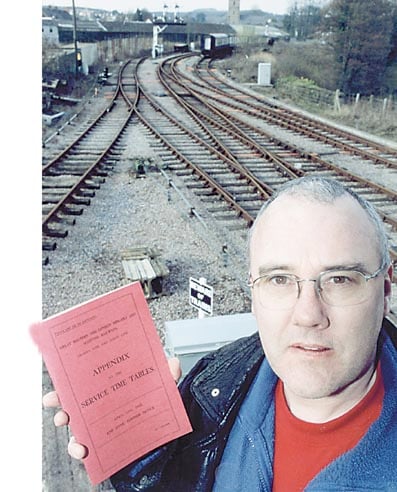
THE map inside the cover of Appendix to the Service Time Tables 1932 (Black Dwarf Publications facsimile reprint £7.50) is a reminder of what the Forest lost when the rail network finally closed in 1964.
Although passenger services were in severe decline from the 1920s when buses provided more convenient local transport, freight – mostly coal and stone – kept the lines viable. The Parkend-Lydney line continued, indeed, until 1976.
The Appendix, running to 48 pages of minutely detailed operating instructions, illustrates how complex a job it was keeping the network going. For a start, in these pre-nationalisation decades, the Severn and Wye Joint Line was run by two companies – the Great Western with its regional HQ at Gloucester and LMS (London Midland & Scottish) with its offices at Bristol.
GWR operated the Gloucester-Newport main line, the Forest of Dean Branch between Newnham and Cinderford, the Hereford line from Grange Court through Longhope to Ross, and the Ross-Monmouth and Monmouth-Chepstow Wye Valley line. LMS operated the Gloucester-Bristol line which the Forest network linked with at Berkeley Road station.

Their traditions, rolling stock, livery, and rules and regulations differed widely, so their joint operation of the lines based on Lydney required this procedural manual.
The lines were also not the dead straight pairs of rails you associate with modern Inter-City services. They were single track, twisting as they followed the valleys' steep gradients, and crossed not just the Severn Bridge but the Lydbrook viaduct as well.
The list of permanent speed restrictions conveys the picture. Crossing the Severn Bridge was a maximum of six miles per hour. Only between Lydney Town and Tufts Junction could trains reach a giddy 20 mph.
On the Coleford branch diverging at Parkend the limit was 15 mph, as it was on the Parkend-Lydbrook "spine" route – slowing to five miles per hour over the viaduct. Towards the top of the Cannop valley beyond Speech House road station, Serridge Junction was the point where the Cinderford branch diverged via Drybrook Road station – the junction for the Minerals Loop Line from Tufts Junction. A final stretch was the branch from Lydney Junction station to the docks plus that from Whimsey up to the Drybrook quarry.
To avoid collisions, trains were only allowed onto the track if the driver or guard was in possession of the token or tablet, details of which are given for different sections of the line.
Such procedures were especially complicated on the stretch between Lydney Junction across the bridge to Berkeley and the swing bridge across the Gloucester-Sharpness Canal. If the Severn Tunnel was closed for maintenance or by a breakdown or accident, South Wales trains were diverted to run across the bridge – or via Gloucester if traffic became congested.
Loadings were scrupulously quantified. Some of the names of goods wagons are weird and wonderful, including "Crocodiles," "Minks" and "Macaws."
For real "anoraks" and local former railwaymen, the instructions for operating at different points along the line makes it possible to reconstruct "virtual" journeys as they would have been made – right down to the taking on of water.
For the common reader, it would be interesting to read the actual timetable – maybe a future Black Dwarf publication? Today it seems like a magical fairy tale to be able to jump on a train at, say, Coleford and reach spots all over the Forest or the wider world.