
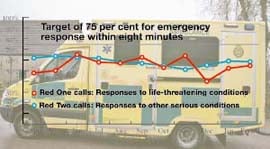
RESPONSE times by ambulances to the most serious emergencies in the Forest failed to reach government targets at any time over a 10-month period.
But a Forest councillor has claimed the target of 75 per cent of ambulances getting to the patient in the two most serious categories within is "unrealistic and therefore unachievable".
Response time figures for "Red One" – immediately life-threatening conditions – and "Red Two" – other emergency calls show the South Western Ambulance Service NHS Trust did not meet the target between April last year and January.
The targets are the same for both rural areas such as the Forest and urban areas such as Cheltenham and Gloucester.

.jpeg?width=209&height=140&crop=209:145,smart&quality=75)
The figures for the Forest presented to Gloucestershire County Council health and overview scrutiny committee showed the Trust's best performance on Red One calls was in June when 65 per cent of responses were within eight minutes.
The worst month for Red One was December when 40 per cent of ambulances arrived within the target time.
The average for Red One calls was over the 10 months was 54.7 per cent compared with 90.1 per cent in Cheltenham and 87.5 per cent in Gloucester.
For Red Two calls the best performance was in May with 63.7 per cent and the worst was in November with 55.1 per cent. The 10-month average was 58.4 per cent.
During the same period the Trust also failed to meet the target to get a vehicle to patients in an urgent but not life-threatening situation in 19 minutes.
Cllr Paul McMahon (Lab, Coleford) said: "Over a table of 36 minimum requirement targets this has never been reached during that time (April-January).
"These figures are quite alarming compared with the response times to Cheltenham and Gloucester which both regularly achieve a target of the low 90s per cent.
"My conclusion is that either the government sets targets that are unrealistic and therefore not achievable or that the ambulance service is a failing organisation.
"I'm convinced the former is the correct assumption."
A spokeswoman for the ambulance trust said: "While the matter of rural response targets is currently being debated at a national level among ambulance trusts, South Western Ambulance Service is very focussed on meeting all response targets and a range of initiatives have been put in place to help achieve this.
"Not only do we recognise the importance of an ambulance arriving quickly but that the care the patient receives in the first few minutes can be absolutely crucial for a good outcome.
To support our patients receiving the right care as soon as possible, there are currently nine community responder schemes within the Forest of Dean."
There are also a number of defibrillators in towns and villages around the Forest which can help save a life if somebody has a cardiac arrest.
The spokeswoman added: "You should always ring for an ambulance if you need urgent, life-saving medical assistance and the emergency call-handler, if appropriate, will be able to tell you if there is a public-access defibrillator located nearby, how to access it and how to use it."
Comments
This article has no comments yet. Be the first to leave a comment.