
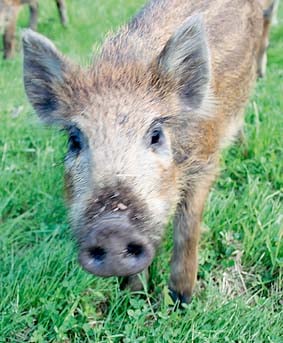
THE FORESTRY Commission has recommended increasing the target population of boar in the Forest of Dean from the figure of 90 that was agreed by the District Council, The Forestry Commission and the Verderers back in 2009, to 400 animals.
At a meeting held in Coleford attended by wildlife ecologists, the Forestry Commission and a representative of Friends of the Wild Boar, the debate over wild boar numbers in the forest centred on a principal stumbling-block: that nobody knows quite how many of the animals are roaming the area, with different sources offering 'estimates' that range from 200 to 600.
In a statement issued by Ian Standing, chairman of the Boar Working Group, they claim: "Because the Forest of Dean is the first substantial area of woodland in Britain used recreationally by the public to experience a sizeable number of boar, research has been needed and is ongoing. Determining the exact number of boar in the Forest has proved to be very difficult and to date management of the boar has of necessity been based on estimated numbers."
He added: "The meeting recognised the difficulty this imposes and it welcomed the new survey work planned for this winter. Doing nothing in the long term is not an option. There are no natural predators and the reproductive capacity of wild boar is very high. With sows producing four or more young each year, a 50 per cent reduction by emigration or humane control is needed to maintain numbers at a stable level."
The meeting failed to agree on boar numbers in the Forest, but one member commented that culling of the boar to 'target figures' should only be considered once defendable, scientifically-derived population figures had been obtained.
The meeting also examined the use of further education and information being made on the safety and on the importance of not feeding the boar. "When boar are fed they become attracted to tourist spots and local villages, and at risk from traffic and non-humane intervention."
Estimating the number of boar or other wild animals is essential for the management of the animals living in an area. This has been made possible in other areas of the UK by the use of thermal imaging cameras operated from helicopters. It is not known if the Boar Working Group have discussed this option.
Comments
This article has no comments yet. Be the first to leave a comment.