

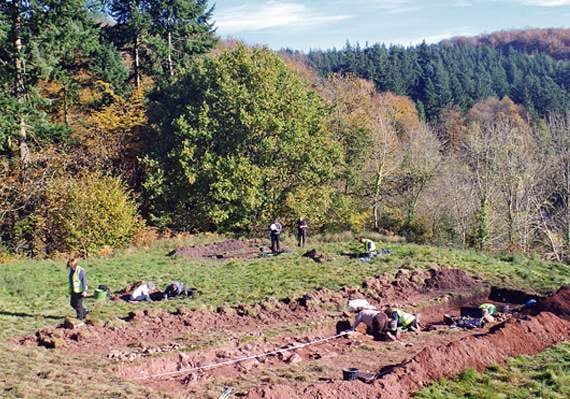
“THE archaeology of the Forest of Dean is difficult – non-conformist is the word I’d use,” said Robin Jackson, who has been leading a team of professionals and local volunteers as they tried to answer some of the many questions about Soudley Camp.
The camp been described as an enigma, a mystery so deep that virtually the only thing known about it was its physical existence.
Previous digs at other sites in the district have led to archaeologists having to rethink them as the evidence from the ground contradicted previously held theories.
There are many theories about when the camp was built dating it from the late Stone Age right through to the Norman Conquest.

The best guess was that it dates back to the Iron Age, sometime between 800BC and the Roman invasion in 43AD.
The major question was: would Soudley ‘behave’ itself and back the experts’ hypothesis or – like sites such as Yorkley – would it be completely different?
The dig at Soudley Camp, perched high on a hill between the Blakeney to Ruspidge road and the village primary school, is one of more 30 projects around the Forest under the umbrella of the Heritage Lottery-funded Foresters’ Forest scheme.
The professionals from Worcestershire Archaeology – a part of Worcestershire County Council – and a group of volunteers had eight days to, hopefully, answer some of the questions.
At an open day for visitors, Mr Jackson said: “The site is an enigma, a mystery. We don’t know what it is, when it was built or what it was used for.”
Despite that, the site has had official recognition as a Scheduled Ancient Monument since the 1960s.
Mr Jackson said: “It means nobody is allowed to dig a hole in this – you are not even meant to bang a stake into it.
“It was probably scheduled because it is visible and it seemed important at the time.
“It was scheduled in the 60s and still is so I’ve had to apply for a licence to dig it for this project.
“It comes from the Secretary of State (for Culture, Media and Sport) and had to be signed by the Secretary of State (Karen Bradley).
“I’ve also had to have a licence from the Forestry Commission for which I’ve had to pay a peppercorn.
“The legal contract for us to dig here actually asked for a peppercorn but they waived it which is a nice piece of historic legal process.”
Although the site has been scheduled for 50 years there has been remarkably little investigation of it.
Mr Jackson said: “The only work that has been done is an earthwork survey by the Dean Archaeology Group and a metal detectorist did some illegal detectoring but reputedly found nothing.
“The only other information we have is a few mole hills and boar scours which turned up a few bits of slag and pottery.”
The scant evidence has made dating the camp, which in the 20th century was a popular picnic site, very difficult.
Mr Jackson said: “The schedule suggests its an Iron Age fort and those ideas are based on the shape of it.
“One suggestion is that it is a prehistoric enclosure, early neolithic, around 3,000BC.”
Other suggestions are that it is a defended Iron Age site – the most popular theory – or is early Roman, because they defended their settlements with banks and ditches, or early medieval, around the time of the Norman Conquest.
“I think it was quite a reasonable place to live.
“It’s secure – you’ve got the banks and the drop aways and, even if they have been modified, they have always been big drops.
“It is also sheltered because you are surrounded by higher ground in a sort of bowl. It works really well as defended settlement whether it be prehistoric or medieval.
“We’ve written off the Romans because we would have found a lot of pottery.”
The team dug three trenches with geophysics and radar being used to help locate them in places where something was likely to be found.
The first trench was dug near the entrance opposite the school car park but, in true Forest style, did not ‘behave’ itself.
Mr Jackson said: “We thought it would be very deep and we wouldn’t get anywhere near the bottom but, oddly, it’s not as deep as we thought – I thought it would be a couple of metres deep and that we wouldn’t get anywhere.
“If there are ditches, they are classic places where people throw things away – if you get rubbish that helps you date the site and understand what was going on.
“This ditch hasn’t any. It has very little in it apart from modern stuff in the top but no useful dating evidence.
“We found one interesting little object, a flint scraper.”
The scraper dated back to 4,000BC but was at the top of the pit, indicating it was what archaeologists call a ‘stray’ find.
But the trench had a story to tell – a pile of rubble was a tell-tale sign that this was a causeway or hard-standing, part of the original entrance.
“This pile of rubble tells you the entrance is original because it is just a mound of loose, jumbled stone which goes down into the ditch and will extend across the entrance.
“It is a hard-standing so you can get carts in and out through a gate – a big timber gate with palisade on top.
“You are coming up to something that is fairly imposing and secure.
“We got some good answers from this but not what date the site is.”
Another trench was dug to test a small piece of earthwork which might have been an internal bank but it yielded very little information.
A large, flat platform running from the entrance bank to the steep slopes down to the road shows that the camp had been subsequently re-used.
“This platform is the sort of thing where we might expect to find a house or, as has turned out to be the case here, of re-use of the site – we think it is a charcoal burning station, we’ve had big lumps of charcoal come out of the trench.
“This is evidence of re-use but we are not getting lots of iron slag – they are not working iron on the site but they are, it appears, burning charcoal.”
What was termed trench two is where the key evidence, a couple of stones – one of which has pointed the finger firmly at Soudley Camp being Iron Age – was found.
One of the stones, found in what appears to be a post hole, had lots of grooves which looked like it had been used to sharpen tools.
Beside it was the crucial piece of evidence, although it was only the top and half of it, of the the complete item.
The domed quern stone – called a beehive quern because of its shape, was used to grind corn.
Mr Jackson said: “We think it is May Hill sandstone, which is a local hard stone used to make quern stones in the prehistoric to Roman periods.
“They go right back to the neolithic but they are most common in the Iron Age and this beehive is an Iron Age form.
“They are used in the Roman period but they are predominantly found on sites that date from 400BC to about the Roman Conquest in 43AD.
“Unlike the flint, this is not a stray find – it weighs quite a lot and is a domestic object for grinding corn for bread.
“This is our best evidence suggesting very strongly that it is an Iron Age defended enclosure and that it’s domestic.
“If that is the case you would probably have two or three round houses, a little shed for animals with 20 to 25 people living here like an extended family and probably making their living from agriculture.
“Hopefully we’ve answered the main question but there are plenty of questions left.”
-------
Learning from the past
THE dig at Soudley was an opportunity for volunteers to learn some of the skills of the archaeologist while local schoolchildren were given a vivid introduction to life in the Forest in the past.
As part of the Heritage Lottery-funded Foresters’ Forest programme, public involvement was a key part of the dig.
Among the volunteers was Caroline Prosser of Milkwall, who was helping to record the trenches and what had been found
She said: “Rather than being involved with digging out, I’m looking at what is there that has been dug out – it’s great fun and I’m learning new skills.
“I was involved with Foresters Forest and the Yorkley dig last year and on that dig I was mainly cleaning finds.
“The experts keep an eye on us and make sure what we’re doing is done in the right way and we’re acquiring skills.
“They have a thing called a skills passport so whichever activity we are involved in, whether it’s the digging or something like recording, we can keep a note of what we’ve done and they will sign us off as novice or competent or whatever.
“It’s developing our skills rather than just learning what is going on here.
Archaeologist Jesse Wheeler said the volunteers had maintained their enthusiasm despite not many finds coming out of the grounds.
She said: “The volunteers have been absolutely brilliant.
“We’ve had some very drizzly days and we’ve not had a great amount of material culture coming out and that is what gets people’s imaginations.
“They’ve been very good at keeping their enthusiasm in the face of drizzle and very few finds and still seeing the bigger picture of the site.”
Children from Soudley and Lydbrook primary schools were given a tour of the site and had a go at animal bone quiz, sorting Roman pottery and put drawings of prehistoric life in the correct order.
Archaeologist Nina O’Hare said: “We were very impressed at the fantastic questions they asked and how well they identified the bones.
“We think there may be some future archaeologists among them.”
Comments
This article has no comments yet. Be the first to leave a comment.