
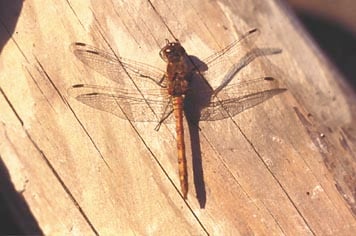
REVIEW WILDLIFE EXPERT IVAN PROCTOR REVEALS THE BEST PLACES TO SPOT HORSE-STINGERS AND DARNING NEEDLES...
High summer days are made for dragonflies. The Forest is quiet in the heat of summer.
Birds are subdued as they go through their yearly moult, which is why the garden robin looks such a scruffy little urchin at the moment. Many flowers and grasses have gone over and bracken covers areas so densely that only the most determined and fly hardened walker can penetrate it.
But when the sun blazes down by the Forest's ponds, rivers and streams dragonflies have their day.




With their brilliant iridescent colours and their large size, dragonflies and damselflies are among the most attractive insects to watch. Big dragonflies can look fierce and this is emphasised when one such as the blue and green coloured southern hawker comes and hovers curiously a foot or two away as you stand by a woodland pond.
Horse stingers was an old name for dragonflies and the smaller, slender damselflies were called devil's darning needles but they are all harmless to us as they neither bite nor sting.
Having said that, within their own community they are top predators, the peregrines and sparrowhawks of the insect world. Both as adult insects and as nymphs living in water they feed solely on other insects and animals. The nymph of a large dragonfly in a pond will tackle prey up to the size of tadpoles.
Most of their life is spent in water. Even damselflies spend a year as water insects and the largest dragonflies in this country spend up to three years growing in a pond or stream. The insects that we see only fly at most for a few weeks right at the end of their life whilst they mate and lay the eggs that will hatch into the next generation of insects.
So the place to look for them is always near water even though you can see occasional ones almost anywhere. The larger ponds in the Forest such as Mallards Pike have dragonflies but the smaller ponds without big fish populations are better sites to search. At Soudley for example the best ponds are the small ones with reedy edges and floating weeds at the head of the valley rather than the big one down by the road.
Rivers and streams have their own species. A fast flowing woodland brook like Cannop is a good place to look for the large black dragonfly with yellow hoops of colour named the golden ringed dragonfly.
Slower flowing stretches of the River Wye are home to two beautiful damselflies, a metallic blue one with a blue/ black band across its wings called the banded demoiselle and the very pale blue white-legged damselfly.
The Forest is so good for dragonflies that even garden ponds will attract half a dozen or more different ones such as the large red damselfly and the aptly named broad bodied chaser.
The hotter the weather the better dragonflies like it as they are mainly a tropical group of insects and our species are ones that have adapted to our cooler summers. There are less than 40 common species in Britain and only about 20-25 will be seen in a Forest year. They emerge all through spring and summer and can be readily identified with a field guide and a bit of practice.
Dragonflies have been called bird watchers' insects and as with birds uncommon migrant species can turn up.
One day in 1996 John Phillips, of Popes Hill, was watching dragonflies at Cinderford's Linear Park when he noticed a strange looking one. It turned out to be a lesser emperor, a species never recorded in Britain before.
In recent frost free autumns dragonflies have been flying well into November and two years ago I even saw one in the first week of December. So there are months and months yet to enjoy these spectacular, sun-loving Forest dwellers.