

Tribute – Harold Read
-------
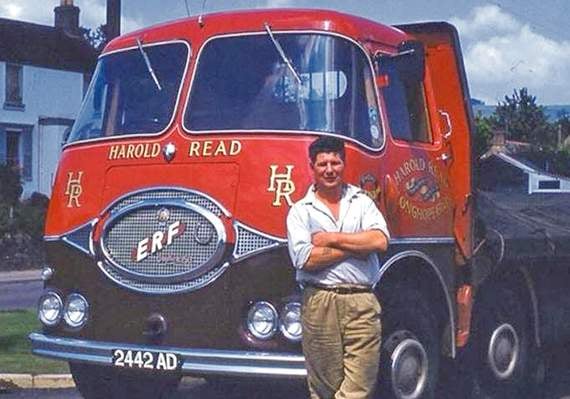
LORRIES were a huge part of Harold Read’s life and he made his final journey on the back of one of them.
The death of the owner of the Longhope haulage company which bears his name marks the end of an era in the business life of the village.
Mr Read’s coffin was taken from his yard in the village to the Forest of Dean Crematorium and a celebration of his life was held at the Chase Hotel in Ross.
The family was steeped in the haulage industry – his father Harry was an early pioneer, he worked as a driver for his brother George and another brother, Richard, also had his own transport business.
Mr Read was born at Thackwell, opposite the Yew Tree Inn at Longhope, in August 1927 and, growing up, he would take any opportunity to go with his father’s drivers.
At the age of 14, his mother, Alice, sent him to learn farming at Ashford Carbonell near Ludlow and, despite another attempt on a farm at Welsh Newton, his heart was never in the industry.
He then went to the army recruiting office at Gloucester, claiming to be 17 when he was only 15, where he was signed up despite the sergeant knowing Harold’s brother Ivor.
As he left the office, Harold was asked how old he was – and the sergeant replied: “Good boy, don’t forget.”
After war service, in 1947, he started work as a driver for George and lorries would again play a key part in his life.
His future wife, Mary, worked behind the bar for her aunt Kath at the Yew Tree and when she was due to return home to Birmingham, he offered her a lift as he was headed to the city.
They later married and lived in the back of the pub.
Their son Phillip was born in 1951 and twins Adrian and Nicholas were born three years later although, sadly, Nicholas did not survive.
Their fourth son, Mark, was born in 1961 but, tragically, he died aged 15 taking part in his much loved hobby of motorbike scrambling.
In 1954, Harold struck out on his own, buying a Leyland Comet from George, hauling coal and later steel from Ebbw Vale.
He went on to operate ERF eight-wheelers, hauling steel from the Llanwern works at Newport, eventually concentrating on bulk tipper work and hauling scrap metal to the town’s steelworks and docks.
Mr Read did not tell his family about his war experiences until he returned to France in 1984 for the 40th anniversary of the D-Day landings.
He was part of an advance party from 1 Buckinghamshire Regiment that landed on Sword Beach on D-Day, 12 hours after the paratroopers and commandos.
His group was ordered to stack ammunition and fuel in several fields but it was bombed and fire rapidly spread, although they managed to save half of it.
The plane was shot down and Harold was detailed to guard the pilot and, to his surprise, found the airman spoke perfect English, having been educated at Oxford before the war – “the pilot could speak better English than me,” Harold would say later.
His regiment guarded the famous Pegasus Bridge and was involved in the fighting in the Falaise Gap before moving onto Brussels.
In the Netherlands town of Delft he saw locals starving before pushing onto Germany where he witnessed the horrors of the Belsen concentration camp.
He also went onto Kiel in northern Germany, the German capital, Berlin, and finished at Trieste in northern Italy.
Last year he was the proud recipient of France’s highest honour, the Legion d’Honneur, given by a grateful nation to those who had liberated it.
Away from work, Harold was a big fan of darts and he and brother Ivor played for local teams.
His friend, Longhope district councillor Dave East, said: “We often reminisced on the days of The Plough Inn before they pulled it down ? you could play cards, shove ha’penny, dominoes and darts.
“Harold loved his darts and if you could hit double top without hitting the beam or the low ceiling, you were a darts player.”
When he was working nights he would find a pub with a board and even joined the team on one of his regular stops.
He was also a member of Aston Ingham bowls club, enjoyed ‘shoots’ with brother Richard and, with wife Mary, enjoyed dancing and horse racing.
They went to most of the racecourses in Britain, including Ayr, where he did his army training. His failing health and need for dialysis forced him to give up his hobbies but he enjoyed watching darts on TV.
Cllr East said: “It is the end of an era: Gladys (his sister), Ivor, Richard, Harold and their good friend Roy Morgan, all over 90, with so much knowledge and history of Longhope gone with them.
“I shall miss your ‘owbe, neighbour’, in the mornings. The village has lost a true villager and friend.”
Comments
This article has no comments yet. Be the first to leave a comment.