
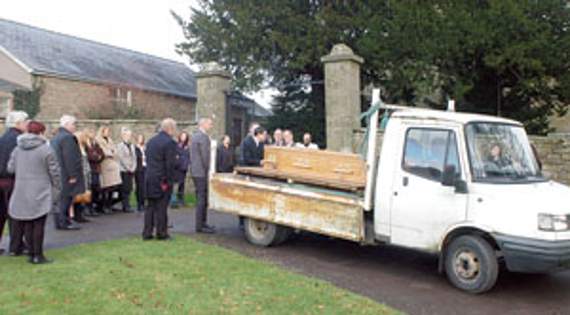
THE funeral of Robin Morgan who – until his death aged 80 on January 26 – was probably the oldest freeminer still active, was attended by dozens of his family, friends and colleagues.
His coffin was carried to the service at Holy Trinity church, Drybrook on a coal truck, and on it also were his white pit helmet, his boots, and a pick that he used to break up coal. He was buried at Mile End. Music at the funeral included Loretta Lynn’s They Don’t Make Them Like My Daddy Anymore, and Working Man by David Alexander.
In a touching tribute and eulogy, Rev Philip Avery said: “Robin was born Robert David Morgan in the village of Steam Mills on October 26, 1935. He was the sixth son born to Lesley and Maise Morgan. Robin, as he was always known, had five older brothers: Dick, Ashley, Peter, Basil and Dink, a sister, Betty, and a younger brother John.
“Times were tough growing up with the family, but they never thought anything of it, as most families back then were in the same situation. There was no money for toys, but that never stopped them from having fun playing football together and getting up to mischief in the surrounding woods.
“Robin attended Steam Mills School and enjoyed his time there, except on a rainy day. The first up was always the best dressed, so he would often have holes in his shoes, which he would fill with cardboard, but by the time he got to the school gates his socks would be wet. Robin then attended Abenhall secondary school in Mitcheldean, but was not keen, so left sooner than he should have, to start his working life in the mines.
“He already had some mining experience, at 13 two of his brothers had dropped him down a shaft in a 40 gallon drum on a hand winch. Enough to put most people off, but he thought it was brilliant, far better than being at school.
“At 14, though, his career in mining officially started, as an apprentice at Northern United. As part of his apprenticeship he got to visit one of the deep mines every week, which he loved, but as a boy was frightened of going down Waterloo, because there was no bottom to the pit, as it was full of water.
“His first job at Northern was spragging the carts, it was very dangerous and in later life he’d say, ‘I’d be scared to do it now’.
“As well as working Robin loved to go out and was a regular at the pubs in Cinderford and Steam Mills. But on an outing, with his cousin Trevor to Barton Fayre, he met Elleen. They they fell in love and weren’t long starting their own family. And went on to have six children: Neil, Linda, Robert, Dave, Elleen and Jane.
“But as soon as the kids came along going to the pub had to stop. There were mouths to feed and Robin wasn’t going to let anyone go hungry.
“After Northern closed, he did everything to make ends meet. He worked in the woods cutting timber, drove lorries for George Reid and dug tunnels under Gloucester and Cheltenham, but all the time worked at his mine in Heyward in the evenings and weekends.
“Through hard work and determination things slowly got better. Robin started on his own laying kerbs; laying a record 508 kerbs in one day. The site foreman called him a freak of nature, but quickly explained that was “a compliment, Mr Morgan.”
“When Robin had finished on the kerbs he owned and worked the Phoenix Colliery in Cannop with his sons Neil and Dave, his brothers Dink and Gary; and his cousin Hedley also worked there.
“Then to Hopewell with the same crew and new member Rich Harding; who knew the mine well, having worked for the previous owner, Bert Hinton. Preserving the forest mining heritage was also important to Robin. He turned Hopewell into a visitors mine, which he ran with Elleen, his son Neil and daughter Jane. And over the years had lots of help from the family and friends.
“He only decided to sell Hopewell 12 months ago to his mate Deg, who now runs it with Rich Daniels, but continued to work there.
“Robin came from a big family and had his own big family six kids and 15 grandchildren. One was a permanent fixture, grandson, Frazer, who followed him everywhere as a kid and was lucky enough to spend time working with Robin down the pit.
“A great man, a gentle giant, that brought his family up with a pick and shovel; a different breed. He will be sadly missed by his children and grandchildren and great grandchildren who, along with friends, will keep his memory alive.”
He added: “See you again, Dad, pump, Robbo.”
Comments
This article has no comments yet. Be the first to leave a comment.