
HUNDREDS of square kilometres of the Forest and south Herefordshire could potentially be opened up to exploration for shale gas.
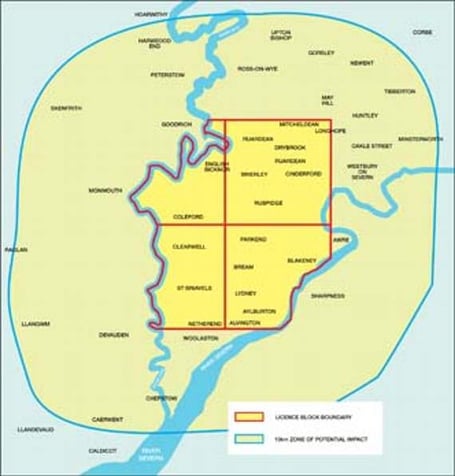
The government has started a consultation on an environmental assessment of 132 ‘blocks’ around England to licence ‘fracking’, including four in the Forest.
Taken together the four blocks cover hundreds of square kilometres with the River Wye as the western boundary.
The southern perimeter starts opposite Tintern Abbey and runs to just outside Alvington and along the Severn to a point between Blakeney and Awre.



The northern boundary runs from the Wye near Walford to Longhope.
The blocks are usually 10km square but on the western side are cut short by the Wye as the Welsh Assembly is not allowing fracking.
Each block is surrounded by a 10km “zone of potential impact” which cover the whole of Forest except for the north of the district around Dymock and Bromsberrow.
The potential impact zones also includes Ross, Monmouth, the Wye Valley and Chepstow while parts of the Forest would lie within the zone of a block in north Somerset.
Fracking, or hydraulic fracturing, is a process of drilling down into the earth to direct a high-pressure water mixture at the rock to release the gas inside. It is a controversial method.
A campaign group against gas exploration in the area, Frack Off Our Forest, has been formed and plans a protest outside Shire Hall in Gloucester before a meeting of Gloucestershire County Council’s planning committee at 9.30am on Thursday, September 3.
Forest MP Mark Harper said even if a licence is granted it would only be the first step in any application to start fracking.
Each of the blocks has been analysed and assessed under the EU Habitats Directive and it is these which are the subject of the consultation.
If it is decided a proposal could have an impact on a site of special conservation value then a more detailed analysis will be necessary.
Energy Minister Lord Bourne said: “It’s important we press on and get shale moving, while maintaining strong environmental controls.
“The habitats consultation, which covers those blocks which do require further environmental assessment, enables the public and other interested parties to submit responses by the end of September.
The OGA (Oil and Gas Authority) will then consider the results of the consultation before offering any further blocks.
Frack Off Our Forest spokesman Drew Pratten said there had a been a surge of interest in the new group with more than 2,000 ‘likes’ on social media site Facebook.
He added: “Everyone is united that in no way will we allow any shale gas fracking, coal gasification or coalbed methane extraction – whatever is proposed, we don’t know yet – in our beautiful Forest.”
Forest campaigners HOOF (Hands Off Our Forest) have also expressed ‘shock and dismay’ and say it again underlines the need for legal protection for the Dean.
Mr Harper said: “Even should a licence be granted in future, it is important to note that licences in, and of, themselves do not allow the licensee to carry out any activity.
“The government has made very clear that before any type of activity can occur it will need planning permission from the local minerals planning authority, be certified as safe by the Health and Safety Executive and receive confirmation that any work will not have an adverse effect on the local environment from the Environment Agency.”
The Forest Council’s Labour group asked Mr Harper to clarify a statement made during the election that there would not be any question of fracking in the Dean because there is no shale gas.
He told the Review: “According to information provided by the British Geological Survey there are no shale deposits in or around the Forest of Dean.
“However, given the mining heritage in the Forest here are coal deposits in the areas which may contain natural gas.”
Comments
This article has no comments yet. Be the first to leave a comment.