
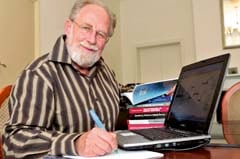
What is the future of the Forest of Dean? It's a question data analyst Laurie Moseley has been thinking about a lot. Used to working out which treatments are the most effective ones for a variety of diseases, and addressing other health care questions (as well as teaching Argentine Tango), he has also been looking at some of the facts and figures our decision makers should be using to shape our future here in the Forest. And some of his findings are bound to raise controversy. In the first of four articles, he asks if we shouldn't be trying to preserve our 'rurality' rather than trying to attract more industry and building superstores...and yet more houses.
LOCAL authorities try to set out their vision of the
future for the areas which they represent.
In our own case, that vision is contained in something called a core strategy. I wish to suggest that the council's present strategy is not a strategy (rather a collection of unrelated tactics) and that it should be replaced. In its place I suggest some genuine strategic principles.
.png?width=209&height=140&crop=209:145,smart&quality=75)
The four principles which should be used to inform any decisions which our local district council will be called upon to make are listed below. They interact, and together they provide a formula for a healthy, happy, peaceful, prosperous, and sustainable district. The principles are:
•We are rural not urban
•We want quality not
quantity
•We plan in the long-term not short-term
• Our population is small, not large
A final over-arching principle would be we intend to keep them like that. If we adopted such principles, the detailed policies should be easy to determine.
Let's look at the first of these principles, that we are rural not urban.
When the Forest of Dean District Council recently undertook a survey of the local population during the production of the Community Plan, the local community said that, of all the factors offered by the questionnaire, the single most important positive characteristic of the area was that it was a beautiful and peaceful rural area. So, local people like our district being rural.
As far as the government is concerned, we are also a rural area. The government has six categories of areas, from the most urban to the most rural. The latter is called R80. The Forest of Dean District is an R80 area – the most rural category that the government uses. In the eyes of the government it is not a metropolis, a city, or even a suburban area – it is rural.
Quite apart from what surveys and government classifications say, our situation at the moment is visible to the naked eye. Anyone driving around the Forest can see that it is a rural area. We take that for granted, and think that it will always be like that.
Of course, many people want to live in urban areas. They have big stores, theatres, many restaurants, and the like. About 70 per cent of the population of the UK live in such areas. However, an increasing number wish to live in rural areas – often for that very peace and tranquillity.
Indeed, last year in a survey of a dozen relevant factors, the Forest of Dean came out as the best place in England to bring up a child. The District Council now proudly displays the results of that survey at the entrance to its offices. However, if nothing is done to protect the countryside, there will gradually be fewer and fewer genuinely rural areas for those who wish to live in them.
The peace and beauty of our landscape is not merely an environmental asset – it is an economic one as well. In the last 10 years some 20 studies have been published by Defra, Regional Development Agencies, consultancy firms, and universities on what leads to economic progress in rural areas.
They have all come to the same conclusion – the single greatest asset for a rural area is the quality of the local landscape. That is what attracts companies, especially modern, knowledge-intensive companies which (a) have a long-term future and (b) generate high incomes. Protecting our rural environment is the single most important economic investment we can make. For attracting modern jobs, it even beats lower business rates! It is not just "an asset", or even "a great asset", but "the greatest asset".
For example, in several areas if the UK, when asked why they had relocated to rural areas, almost 70 per cent of modern knowledge-intensive companies gave the environmental quality of the area as one of the major reasons for their choice, Similarly, the Taylor Report last year on a Living, Working, Countryside, noted that in recent years the growth of knowledge-intensive industries had been 21per cent in urban areas, but 46 per cent in rural areas, i.e. the growth was twice as high in rural areas.
We should cherish the beautiful area in which we live not only for its aesthetic and environmental benefits, but for its economic ones as well. Every piece of countryside destroyed by an unnecessary housing estate, lorry park, or massive megastore is one more nail in the coffin of our long-term economic progress.
When a planning proposal comes before the District Council, the first question they should ask ought to be "Will it make us less rural?" If the answer to that question is "Yes", then the proposal should be rejected.
Comments
This article has no comments yet. Be the first to leave a comment.