

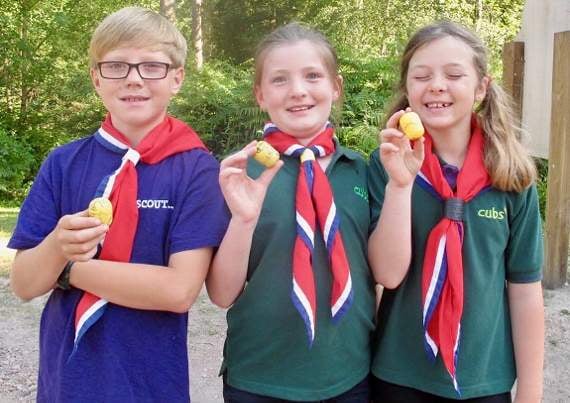
A CUB pack has been taking part in a national initiative to find out how humans would cope with life on Mars.
The Future Martians MARSBalloon project enables children to carry out Mars-analogue science experiments.
Capsules containing everyday items put together by 1st Woolaston Cubs were launched on a high-altitude balloon carrying them above 99 per cent of the Earth’s atmosphere, where conditions are very similar to the surface of Mars, with a temperature of -50°C, pressures 1/100th that of sea level and with increased radiation.
When the balloon reaches an altitude of 30km, more than twice the height of commercial airliners, it bursts, and the capsules return to earth.


A parachute helps to break their fall and the Bristol-based Thales Alenia Space team use a tracking device to locate them.
The Cubs sent up capsules containing seeds, popcorn kernels, sun cream and paperclips to test their response to the Mars-like conditions.
Since their return, the cubs have been assessing their properties versus control samples that remained on Earth.
Pack leader Emma Care said: “The aim is to give young people practical experience of designing things to go into space and get them thinking about the possibility of visiting other planets.
“Our Cubs had some brilliant ideas and it was great to see them thinking strategically and scientifically about how to approach this challenge. I’m quite sure we have some future scientists and engineers in the pack.”
The experiments have already produced some surprises.
For instance, the spring onion seeds launched into space germinated more quickly than the control seeds.
The 1st Woolaston Cubs meet on Mondays and new girls and boys are welcome to join.
Contact [email protected] for more details.
For further information about the MARSBalloon project go to www.thalesgroup.com/en/futuremartians
Comments
This article has no comments yet. Be the first to leave a comment.