
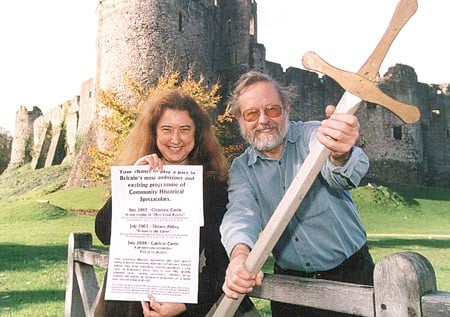
The Monmouthshire Millennium Festival company is offering residents the chance of a part, or backstage role, in next summer's epic sound-and-light show in the grounds of Chepstow Castle.
With a £25,000 Millennium Fund grant, they are preparing a new staging of "Most Loyal Knight", the story of the castle's early lord, William Marshal, who became the country's leading warrior and statesman.
William was fourth son of John Marshal, a knight who fought for the Empress Matilda in the civil wars with King Stephen. When her son was crowned as Henry II, John was rewarded with modest estates.
As a younger son, William had to make his own way in life – initially earning a living by jousting in French tournaments.
Aged 22 in 1168, and recently knighted, he accompanied Henry II's queen, Eleanor of Aquitaine, on a hunting trip near her Poitiers capital – together with his uncle, the Earl of Salisbury. They were attacked by a band intent on kidnapping and then ransoming the Queen.
Lacking armour, the Earl was stabbed to death. While Eleanor escaped, William fought the attackers – being wounded and captured.
Eleanor, who had already noticed the tall, brown-haired youngster in a tournament, ransomed him and rewarded him richly. She also appointed him companion and guardian to her eldest son, then 13.
Thus began William's rise, although he hit a bumpy patch a few years later when Henry falsely accused him of an illicit affair with the Young King's bride. Once more poor and homeless, he made a pilgrimage to Cologne to pray for his name to be cleared.
It was, but Henry died soon after. His dying plea was for William to fulfil the vow he had made to go crusading in the Holy Land. He did so, winning great acclaim.
Back in England, he fought on Henry II's behalf against his always rebellious sons. In one such battle he unhorsed the future Richard I but spared his life.
On Henry's death, he was joint marshal at Richard's coronation. For his services to the crown, he was given the hand of Isabel de Clare – an heiress so rich she had been kept in the Tower of London for 13 years following her father's death.
His new estates included Chepstow castle (then still called Striguil), which he set about enlarging. He was much engaged in fighting in the newly-colonised Ireland, where he was further vast estates.
On Richard's death, William supported John's succession – serving as Marshal of England with the title of 1st Earl of Pembroke. On John's unlamented death, he virtually ruled England as Regent for John's son, the nine year-old Henry III.
Aged 70, he personally led the king's forces against rebels and invading French at the battle of Lincoln. He died three years later, having taken the habit of the Templars. The Archbishop of Canterbury called him "the best (most loyal) knight that ever lived."
William was succeeded in turn by his five sons, all of whom died without heirs. The estate was thus inherited by one of his and Isabel's five daughters.
"The shows are unique in Britain in their scale and the drama of their open-air settings in ancient monuments," says Chepstow potter and co-producer Ned Heywood.
"They have a recorded soundtrack, using the voices of professional actors, dramatic lighting, huge image projections and stunning pyrotechnics.
"The cast numbers over 100. Behind the scenes are set designers and constructors, prop-makers, costume makers, administrators and dozens of others.
"Some professionals are involved, but it remains very much a community production. You don't need any experience to apply – although for those involved in stage fighting, rigorous training will be given by a professional fight director!"
The show, spread over three weekends in July, begins casting in January. The organising committee requires applications for actors and technical staff to be sent c/o the Chepstow Museum before Christmas – application forms being available at local libraries and museums.
Volunteers should beware the experience of one aspiring thespian when the spectacular was last performed. Hoping to figure as one of the Marshal family he ticked the "marshals" box on the application form – and later found himself listening to the show from the car park.