

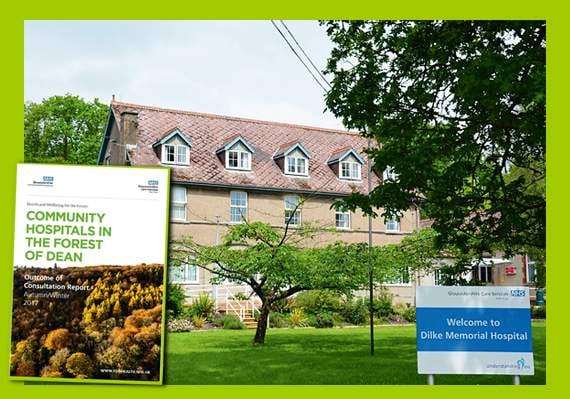
THE lack of information on the site for a new hospital and the number of beds were among the key issues that cost vital public support.
In a recent consultantion, 46 per cent said they were against replacing the hospitals at Lydney and the Dilke with 43 per cent in favour and 12 not coming down on either side.
Despite that, both Gloucestershire Care Services (GCC) and the Gloucestershire Clinical Commissioning Group (CCG) decided the ‘case for change’ and its ‘preferred option’ of a single new hospital did not need to be “revisited.”
But health chiefs say concerns around the number of beds, transport, an ageing population and the heritage of the two hospitals has resulted in resistance to the plan.


They also say that publishing a minimum number of beds – 24 – has led to it being misread as the actual number.
The boards of both organisations met at Forest Hills Golf Club in Coleford last Thursday (January 24) to consider the next steps.
Becky Parrott, of the CCG said: “We asked people why they didn’t support the preferred option.
“There was a lot of feedback on the number of beds, travel and transport came up very high as did changing demographics.
“Other items related particularly to the heritage, the current facilities, location and cost cutting.
Quite a few said they would support the preferred option if there was additional information, mainly the location and more detail about the services.
Katie Norton, the chief executive of Gloucestershire Care Services said: “It is absolutely essential we do more work to provide more assurance that the bed modelling rationale for that is taken forward openly and transparently to reassure everybody that what we are trying to do is right for the future and we are providing facilities in the right place.”
A question from a member of the public suggested the case being put to the board failed to confirm there would not be a loss of beds.
Ms Norman said while local GPs supported the single hospital proposal, they had raised issues around ensuring the right capacity “and that links to the number of beds” which she hoped could be “addressed quickly”.
Health chiefs also point to new ways of caring for people which mean they do not have to go into hospital such as Forest Rapid Response which will this year treat 750 people with urgent medical needs at home rather than hospital.
----------
What happens next?
THE eventual decision on whether to proceed with a new hospital rests with the boards of Gloucestershire Care Service (GCS)s and the Gloucestershire Clinical Commissioning Group(CCG) – but there are a couple of stages to get to that.
The first step is to appoint independent experts to convene the panel that will put recommendations to the boards.
That panel, which will be made up of local people, healthcare professionals and managers, will meet in public and will hear from organisations.
Ellen Rule, CCG’s director of transformation and service redesign at CCG, said: “There are companies that are skilled in making sure we get the right representation across the community.
“A panel like this (will meet) in public and organisations can make representations.
“We would probably need it to sit for a couple of days and we would expect that quite a wide range of people would want to make presentations to that panel.”
The final recommendation to the boards would be guided by a number of criteria on the location of any new hospital including the need for it to be no more than 30 minutes’ drive for most Forest residents and to be accessible by public transport.
----------
Why not rebuild?
AMONG the alternatives put to the health boards was investing the £11 million earmarked for the new facility in the existing hospitals.
A question from a member of the public included the comment: “There’s no reason why the trust cannot improve, or if necessary, rebuild facilities on the current two sites, given that Cheltenham and Gloucester have been rebuilt and improved on their own sites.”
But while managers praised the quality of care at the hospitals, they say it is becoming increasingly difficult to maintain services across the two sites.
Director of nursing at Gloucestershire Care Services (GCS), Sue Field, said: “It is good care but it could be even better.
“I have a workforce who are having to manage services in quite a complex way which is compromising continuity of care.
“It is not unusual for someone to attend the minor illness and injury unit at the Dilke to find there is no radiology there because that day they are being provided for outpatients at Lydney.
“There are very practical operational issues that colleagues manage magnificently but it is not the way we want to provide good continuity of care.”
Candace Plouffe, chief operating officer of GCS, said: “Clinicians who provide services in the two hospitals do a stellar job but they come up against old infrastucture.
“We do most of the nursing in large bays and, from time to time, the hospitals get closed for patient admissions.
“It is hard to contain and manage infection control – this year both norovirus and flu have caused some pressure in the Dilke but also in Lydney.
“We would like to offer en-suite rooms with toilets and showers from a privacy and dignity point of view.
“We are in discussion with colleagues from the acute trust about what out-patient services should be provided locally and what tech we can use to link the two so people are not having to travel into Gloucester Royal.”
Finance director of GCS, Sandra Betney, said the new hospital was affordable but that one-off cost was different to on-going maintenance which is where the pressure comes from at the existing sites.
---------
‘Investment for all’
THE proposal for a new hospital was welcomed by Coleford GP Dr Lawrence Fielder.
Dr Fielder, who is a member of the Gloucestershire Clinical Commissioning Group board said: “This capital investment represents an investment in the healthcare of all Forest people.
“The Forest has the highest incidence of chronic diseases compared with the rest of Gloucestershire, one of the highest suicide rates – which represents the deprivation and isolation of the area – and we have an increasingly elderly population, particularly over the age of 85.
“I think this is an exciting opportunity to advance investment in healthcare in the Forest which has not, if we are honest, been present in the past and I think it needs to go forward.”
---------
Berry neutral?
ACCORDING to one suggestion, squabbles between Lydney and Cinderford over the site for a new hospital could be avoided by placing it somewhere “neutral” – like Berry Hill.
A question submitted to the Gloucestershire Care Services board stated: “I think the hospital should be built in a neutral place,” – although when that was read out, a comedian in the public gallery suggested “Switzerland”.
The question continued: “The two ends will never agree on this – the suggestion is the former college.
“The site is owned by the Homes and Community Agency and is central to East Dean and Lydney.
“It meets the 30-minute travel time, has on-site public transport facilities, utilities and communications and there is room for expansion.”
Comments
This article has no comments yet. Be the first to leave a comment.