THE evidence of a huge ancient buiding in Monmouth which could pre-date the pyramids has British archaeologists sitting on the edges of their seats.
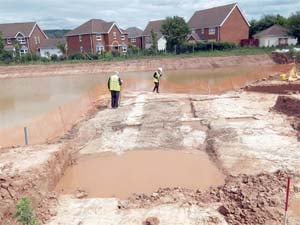
The finds were made by a local rescue archaeology team working on a housing development off Rockfield Road.
The developers of Parc Glyndwr, Charles Church East Wales, have reorganised their work in the area to accommodate the excavation of the remains which came to light during the digging of an overflow pond.
The huge building is unlike anything found in the area before, says Steve Clarke of Monmouth Archaeological Society. It sits at the side of a large lake which has long disappeared.



A spokesman for the archaeologists said that the size of the structure was stunning – it had been made of wood and was at least 50 feet long (15 metres) with one end lost and the other continuing beyond the excavation.
The building is easily large enough to be one of the very rare 'longhouses' or halls of early New Stone Age date which would be older than the Egyptian pyramids although it appears most likely to be of Bronze Age date.
Monmouth Archaeology (a professional wing of Monmouth Archaeological Society) has been employed by Charles Church since work began in order to safeguard any archaeological discoveries. The managing director, Mr Steve Williams, said that the discovery was very exciting and that his company was pleased to be able to support the archaeologists in their work to preserve by record such nationally important remains.
The developers are also funding radio-carbon dating of charcoal and bones found at the site as well as a study of many species of water snails which were found preserved beneath a layer of peat, up to a metre thick, at the bottom of the vestiges of the lake. Today, the centre of the lost lake is marked by a small copse of trees which is being retained on the development as part of the wildlife habitat.
So far only a few flints have been found to pre-date the building while a number of archaeologists specialising in prehistoric remains have also admitted to being baffled. However, everyone agrees that the settlement is prehistoric so unless the excavation produces more definitive finds establishing a date will have to rely on the results of the radio-carbon tests which are being carried out in Scotland.
Around 20 Neolithic 'longhouses' are known from the British mainland and if the Monmouth discovery is one those then it is clearly amongst the biggest. An exceptional feature is that the construction was based on three massive parallel 'sleeper beams' – timbers roughly hewn from complete trees which were set in the ground horizontally. One of these timbers is a metre wide and all of them seem to have been from full-grown trees. Most known longhouses were based on posts.
Another extraordinary aspect of the discovery is that it was built on top of a prehistoric 'burnt mound' – this is a concentration of thousands of 'pot boiler' stones and pebbles which had been burned in a fire and used to boil water when dropped into a pot or water-filled clay pit. There were four of these burnt mounds on different levels of the site, demonstrating that there were successive occupations here over hundreds or thousands of years.
The prehistoric settlement lies on the banks of an ancient lake which silted up over thousands of years – perhaps starting shortly after the last glaciation of the Ice Age. It is the fate of all lakes and ponds to silt up – lake to swamp, swamp to marsh, marsh to bog and bog to dry land – trapping evidence from across millennia.
Comments
This article has no comments yet. Be the first to leave a comment.