
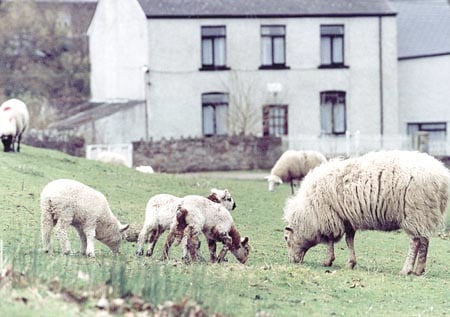
Sheep have been an essential part of the Forest of Dean for hundreds of years. True enough they can be a nuisance. They wander into the path of traffic with phlegmatic equanimity. If you leave your garden gate open for a couple of minutes half a dozen moth-eaten sheep will materialise out of thin air and wander in to lunch on your favourite plants. But take the sheep out of the Forest and it will be a different Forest.
Foot and mouth disease has brought about a situation that nothing else could – no sheep. And who can say how many sheep will return when they do come back? Sheep farming in the Forest isn't a rich man's occupation and who would blame any badgers who decided now that enough was enough?
So for wildlife and the woodlands what are the likely effects and implications of sheep being taken out of the Dean?
To start with things may look fine. This spring wild flowers will flourish. If bluebells come out before the bracken grows they could make the best show for many years.
 Road closure following serious collision in the Forest of Dean
 Almost 2,000 ultra low emission vehicles registered in the Forest of Dean – as campaigners group call for more equal access across UK
 Road closures: six for the Forest of Dean drivers over the next fortnight
 Missing girl found safe and well
But everything normally controlled by grazing will also grow away. In just one summer bramble can put on ten feet of growth. Protected under brambles the seedlings of trees and bushes can get established and then survive even after grazing starts again. Woodland herbs will be choked and the increase in scrub along grassy tracks and in open woodlands will be accelerated.
Holly readily invades abandoned wood pasture and if it gets away above a sheep's reach it will quickly close out the attractive distant views through the trees. Holly's all-year-round dense shade soon eliminates woodland flowers and the variety of plant life will be impoverished.
What about woodland birds? The lack of dead sheep will mean less carrion for crows and other scavengers but that is unlikely to be important with road casualties such as grey squirrels and rabbits still available.
Blackcaps, garden warblers and other birds nesting in dense cover will benefit. Birds needing open woodland or bare ground will suffer. As luck would have it this second group contains birds such as pied flycatcher and redstart which are already in decline. If grazing were not restored to its past level it would be even harder to keep open areas for ground nesting birds such as nightjars.
Other groups would see the same winner/loser situation. Honeysuckle might grow more freely in the woods and that would benefit the white admiral butterfly whose caterpillars feed on its leaves. It would also help dormice who use honeysuckle bark to weave into their nests and who feed on nectar from its flowers in midsummer.
On the other hand small pearl bordered fritillary butterflies who are hanging on in the Forest with a colony around Burnt Log and Moseley Green are entirely dependent on grazing to maintain the conditions they need. There is no way, for example, that Forest Enterprise would have the resources to mow these areas to make up the lack of grazing.
We are all aware of some of the negative aspects of the grazing regime in the Forest; the cut enclosure fences, the uneven standards of animal welfare and husbandry, the overgrazing in some places and the dead sheep left lying around the woods. The sheep owners and the powers that be, MAFF, the County Council and Forest Enterprise, now have the opportunity and the responsibility to address these issues.
Sheep are needed to maintain the richness and variety of the Dean's environment. Let us look forward to when this grim business is over and sheep are safely grazing our woodlands once more.