

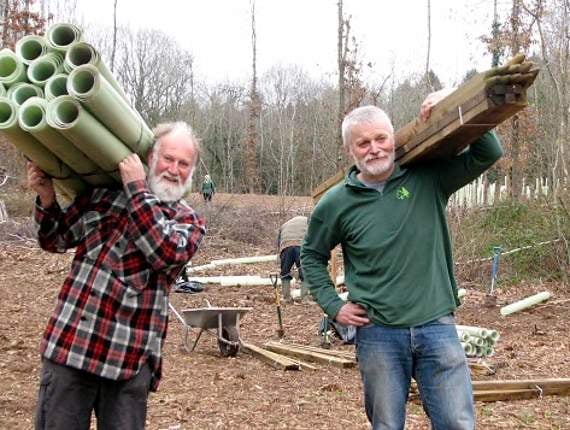
SOME 500 trees have been planted by volunteers in a glade in the ‘Golden Triangle’ on the Gloucestershire-Herefordshire border to mark a number of centenaries.
The ‘centenary glade’ near Kempley celebrates 100 years of the Forestry Commission, local Women’s Institutes and the sale of the Beauchamp estates, which included Kempley and Dymock.
But as well as acknowledging the past, the planting also makes a statement about the importance of tackling climate change and improving biodiversity.
The glade is part of a wider initiative by the Dymock Forest Rural Action group (Dyfra).


Some 70 people, including schoolchildren, members of Women’s Institutes, groups such as Transition Newent, parish councillors and Forestry Commission staff, took part in the planting.
It took place on Friday, March 1, which is the start of the wild daffodil season.
The border area became known as the Golden Triangle because of the unparalleled display of daffs.
Dyfra’s Chris Bligh said: “It is about memorialising, but also the immediate concern around climate change.
“Earl Beauchamp who owned the three big estates of Dymock, Kempley and Redmarley sold them in 1919.
“The founding of the Forestry Commission was as much to give returning men work to do as a defence contract to re-tool the woodlands for the next war – particularly for pit props – but there was also the idea of being self-sufficient in resources.
“It was a time of austerity, it was very hard around here in this really rural environment.
“The WI was also set up here at this time.”
“The government wants to plant trees and this is the way to do it.
“The ambition was that it would be a community project so they own it and it will be looked after and cherished .
“Around the world sustainability is about local management and care.
“Although this is a public utility and the Forestry Commission now has the right strategy for conservation and therefore biodiversity, the immediate concern is climate change and we need to be able to – sequester is the word – as much carbon as possible into a variety of trees.”
Most of the trees planted were alder buckthorn which aregood for butterflies and other species including the wayfaring tree, or hoarwithy, which also provides much-needed habitat.
Among the volunteers was Mark Rusby of Upton Bishop who said: “I walk these woods a lot and its a fabulous place.
“These things don’t happen unless people turn out and it’s amazing how many people have turned out.”
The president of Upton Bishop Women’s Institute, Jane Pendlebury, said being involved in the centenary glade project was a “wonderful” way to mark the group’s 100th anniversary.
It has a number of other events to mark the anniversary, including planting an oak tree, a traditional symbol of the Women’s Institute.
A book charting the history of Upton Bishop WI is being produced and all members will receive a commemorative badge.
Children from Redmarley Primary School and Ann Cam Primary School in Dymock also took part in the planting.
Comments
This article has no comments yet. Be the first to leave a comment.