
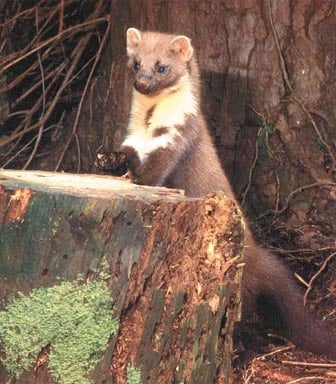
THE elusive pine marten is alive – but perhaps not very well – in the Wye Valley and the Forest, says a wildlife protection group, and it wants help from Review readers to keep an eye on numbers.
"It is certainly very rare but there is strong evidence that the native pine marten is definitely present in the Wye Valley and Forest," said Dr Johnny Burks of Ledbury-based Vincent Wildlife Trust (VWT).
"It is after all the ideal area for it with lots of rocks and trees. However it is not doing particularly well and we would like to find out why – we are very keen to hear any reports of its whereabouts."
He said VWT had been opposed to moves in recent years – reported in the Review – to reintroduce pine martens to the Forest. It was a scheme now "very much on the back-burner".




"This is because the reintroduced animals, imported from Scotland, would compete with the native, population, and we are anxious to know what is limiting its success here first," said Dr Burks.
In a comment paper on the reintroduction proposals the VWT states it believes reintroduction may play some part in the future.
"However, we believe such projects should not be undertaken lightly or hastily," it says.
"Regrettably there has been some disagreement over the past six years about the status of pine martens in England and Wales, and about priorities for conservation action."
It says it is believed by some that no martens live south of the Scottish borders but VWT has "convincing evidence" of sparse and elusive populations in some areas that are probably struggling – including the Forest and Wye Valley.
Founded in 1975 by Vincent Weir, the Vincent Wildlife Trust is an independent charitable body engaged in wildlife research and conservation.
Since its inception, the VWT has focused on the needs of British mammals. Current work is centred on bats, polecats, pine martens and the dormouse.
The VWT also manages more than 40 sites in England, Wales and Ireland, most of which are bat roosts.
Dr Burks said he would be really grateful to hear from readers who sighted martens, which would help them build up a picture of its distribution and help protect its survival. He can be contacted at the Trust on 01531 636441.