
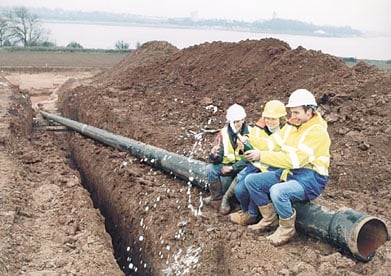
THE MAJOR engineering project to run a gas pipeline under the River Severn to the Forest has been completed despite atrocious weather turning the project into a mudbath.
The fantastic feat of drilling from Sharpness across to Lydney and the winching back of a massive mile-long steel pipe ended with a champagne celebration in the sleet last week.
"All we need to do now is connect it to the plastic mains already laid and fit valves," said project manager Trevor Clark, looking at the point the steel pipe rises out of the mud in a field at Purton, near Lydney.
Behind him was three years of work on the £1.5million project during which surveys for bats, badgers and other wildlife and careful archaeological exploration all played their part.


"It is an amazing engineering feat and this is a very big day," said PR for gas distributors Transco, Caroline Davidson, who has enthusiastically followed the project from start to finish.
And Trevor Clark added: "We have proved just what we can achieve to a lot of people who said it couldn't be done under these very difficult conditions."
A consortium of Transco, specialist drilling firm Stockton Pipelines (one of only a handful of firms able to tackle such a job in the world) and pipe laying specialists Morrison Utility Services undertook the work.
Weeks of drilling by a powerful 250-tonne rig drove the initial hole in a gentle curve 16 metres deep under the Gloucester-Sharpness Canal, the Severn Estuary (following roughly the route of the old Severn Rail Bridge) and the Gloucester-South Wales rail line before emerging in the Purton field.
It was guided by sophisticated sensors which enabled engineers to pinpoint exactly where the drill head was at any given time.
"It all went fairly smoothly under the river where the rock is fairly soft mudstone," said Trevor. "But we did encounter fissures or gaps in the rock which were left after the Ice Age. This meant that the drill head, which we have to keep lubricated with mud, was in a void. We also found harder rock on the Lydney side."
Worse, though, was the relentless rain in the autumn which flooded operations on both sides of the river.
Once the drill got through, it was fixed to one of two half-mile lengths of pipe and winched back, drawing the pipe after it – an operation which alone took some 16 hours.
The completion of the incredible feat has avoided driving a massive pipeline through the Forest to Ross-on-Wye – an even more costly alternative with many environmental problems.
It will now augment supplies to the Forest area and contend with future energy needs, said Caroline. It will also help the Forest cope with exceptional demands like a severe winter – British Gas plans for a 'stinker' every 20 years.
After connection the pipe will be thoroughly tested before being put into commission, and then like all major gas pipelines it will be 'flown' – checked by helicopter – at least every two weeks to make sure nobody is anywhere near it with a mechanical digger, or other risky operations.
"It seems a long, long time since we first talked to the Review about the project and it's hard to believe that we've finally made it," said Caroline.
The specialist teams who completed the donkey work are packing up and moving on to new challenges in Europe – our gas pipes are now tied into a vast system which reaches as far as Siberia.