

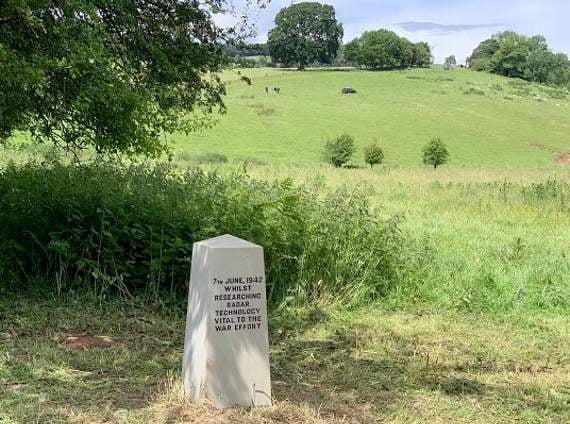
A RIVERSIDE memorial to 11 scientists and air crew who died in a wartime ‘radar laboratory’ plane crash 77 years ago this month has been unveiled following a £5,000 fundraising appeal.
The Forest of Dean stone memorial has been installed at the site of the Second World War disaster near Welsh Bicknor, and pays tribute to the memory of those who perished, including world renowned stereo sound inventor Alan Dower Blumlein.
The converted Halifax V9977 bomber came down below Coppett Hill on the Courtfield Estate on the afternoon of June 7, 1942, in Britain’s worst ever military test flight tragedy, killing four scientists and seven members of the RAF.
Their pioneering airborne radar work helped secure Allied victory over Nazi Germany, but was overlooked for decades after Winston Churchill ordered news of the disaster to be hushed up.



But the new memorial, which was unveiled beside the Wye Valley Walk in front of family and friends of those who perished, is set to throw new light on the sacrifice they made.
Blumlein’s close colleague, radio astronomer Bernard Lovell, who was later knighted for his work at Jodrell Bank Observatory, gave up his seat to another scientist on the ill-fated flight, and was affected by the tragedy for the rest of his life.
Sir Bernard, whose daughter Judy Spence was among those attending the unveiling, had the harrowing task of sifting the wreckage on the night of the crash to recover the highly-secret cavity magnetron the plane had been carrying.
The death of Blumlein, who was 38, robbed the Allies of a driving force in the top secret development of H2S airborne radar, which would be used to identify land targets and U-boats.
The scientists and crew had taken off from RAF Defford near Worcester on the Halifax, but perished on the return journey from south Wales when the aircraft commanded by Pilot Officer Douglas Berrington caught fire 15,000ft over the Forest of Dean and plummeted to earth.
Blumlein – who was posthumously honoured with a Grammy technical award in New York in 2017 – died alongside close EMI and Telecommunications Research Establishment (TRE) colleagues Cecil Oswald Browne, Frank Blythen and Geoffrey Spencer Hensby.
Blumlein’s sons, Simon and David, and Mike Phillips, son of Flying Officer Alger- non Phillips, lifted a Union Jack to unveil the memorial at the Sunday, June 10, ceremony, which was attended by some 70 people, including Jerome Vaughan of the Courtfield Estate, who gave permission for the stone to be sited beside the crash site, overlooked by an oak tree.
Simon Blumlein told the gathering his mother Doreen had once said while visiting the site: “If you have to die, this is a beautiful place.”
Mr Phillips read out the letter his mother received informing her of her husband’s death, urging her to take comfort from his contribution to the war effort.
“Today means every- thing to me,” he said. “My mother was two months pregnant with me when my father died, so I never met him. But he was always in my heart.”
And he added that when he died, his father’s photo of the 22 men he trained with in the RAF had crosses against all but him and another man, indicating that they had all been lost.
Simon Tarlton, assistant curate of St Mary’s Church, Ross-on-Wye, gave a blessing and read out the names of the dead, who also included Leading Aircraftman Brian Dear, Flight Sergeant Gavin Miller, Aircraftman B Bicknell, Squadron Leader Ronald Sansom and Pilot Officer CE Vincent.
Alan Blumlein’s grandson, also called Alan, said after the ceremony: “The very special memorial stone will forever mark the place where the crash occurred and recognises the terrible loss of life that was also a national disaster during World War Two.
“Alan Dower Blumlein was one of the men killed, along with other colleagues from EMI, the RAF and the Telecommunications Research Establishment (TRE).
“H2S radar, being tested on Halifax V9977, was a cutting edge “Air to Surface” radar system that went on to help win WWII.”
He also thanked Hereford Times walks writer Garth Lawson for leading the campaign to raise the money for the memorial stone.
Describing his grandfather, he said: “He was one of the greatest electronics engineers ever to have lived, contributing not just to the world of audio but to early telecommunications, the television system adopted by the BBC in 1936 and, during World War II, in the development of the crucial H2S Airborne Radar system.”
The sacrifice of the 11 men is also remembered by a memorial stained glass window which was installed at Goodrich Castle chapel on the 50th anniversary of the crash.
Comments
This article has no comments yet. Be the first to leave a comment.