
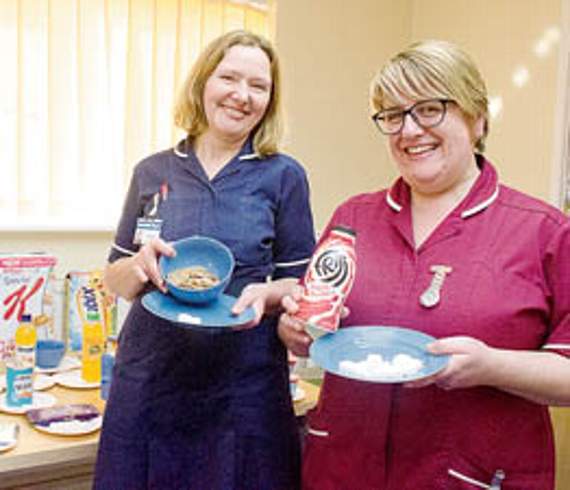
IT’S one thing to read that the drink in front of you contains 40 grams of sugar – but it somehow seems more real when that is represented by 10 lumps of the sweet stuff.
A table laden with everyday foods and drinks – with sugar lumps showing how many four-gram teaspoons they contained – prompted much interest from the visitors to a Lydney surgery’s first diabetes awareness day.
According to organiser Jo Edginton, who is practice nurse and leads on diabetes at the Severnbank Surgery, type two diabetes – which is linked to diet and lifestyle – is a growing problem both locally and nationally.
Jo brought together a range of health professionals and support groups to enable members of the public to find out how a healthier lifestyle can prevent the onset of the condition or help manage it.

.png?width=209&height=140&crop=209:145,smart&quality=75)


As well as the display revealing the amount of sugar in various foods, there was also a spread of tasty, healthier treats cooked by staff at the surgery with ingredients donated by local supermarkets Tuffins, Tesco and the Co-op.
While sugar does not directly cause diabetes, people who are overweight are more likely to contract it – and sugar contains a lot of calories which contribute to weight gain.
Jo said: “Events like this are about to give people all the information they need to look after themselves and make healthy, informed choices.
“What we are trying to do is show people you can have tasty, healthy options that don’t take too long to cook.
“It’s trying to educate people that it’s not about completely denying all foods – we are not trying to get you to sit there with just a lettuce leaf.
“It’s about making choices and hopefully making the better, healthier choices.”
It took about six months to organise the event which included dieticians, specialist nurses, a psychologist and the Forest Council’s exercise referral scheme.
Jo said: “Type two diabetes can be put down to diet and lifestyle – things such as not doing enough exercise.
“The instances of newly-diagnosed diabetics are growing year-on-year.
“It used to be perhaps half a dozen a year but we’re only into April and already I’ve 10 or 11 newly-diagnosed diabetics this year. It’s becoming a huge problem.
“It used to be known as late-onset diabetes so people got it in their 70s or 80s but now people are getting younger and younger so we are seeing 40 year-olds and even 30 year-old sometimes.”
She said that for some patients being able to put a name to symptoms was something of a relief.
“If they have symptoms such as thirst, going to the toilet, getting infections that are not clearing up they know something is not right.
“They can put a name to it but it is still a shocking thing. It is a life-long condition people are having to live with.
“To have that for the rest of your life and having to manage that condition is a hard thing to face.
“It’s trying to get people to focus on their diet and lifestyle and to help them make a few changes to help manage the condition.
“Diabetes is also a progressive condition so most people want to know they are not going to go onto insulin injections.
“We can’t say they won’t ever go onto insulin because there may be something that happens further down the line.”
Jo also said she had been in two minds about the display showing how much sugar there is in everyday foods.
She said: “I was sat there with sugar cubes thinking about whether we should have it.
“When people come to diabetic clinic I always tell them to read the labels – but having a visual of how much sugar there is in these food is hard hitting.”
Around 100 people attended the event and staff are now considering putting on similar days for other conditions and discussing with colleagues in other parts of the Forest about holding events.
Among those who attended the day was Dave Woodward of Lydney who has Type 2 diabetes.
He said: “It has been very interesting and I’ve picked up some useful information.”
Geoff Davies of the Forest of Dean support group of Diabetes UK praised the initiative.
He said: “There are a lot of events for professionals but you don’t get much for patients so having something like this where people can just drop in and have a chat is a very good idea.”
The support group meets on the first Monday of each month, except August and September, at the Sling Club near Coleford.
Comments
This article has no comments yet. Be the first to leave a comment.