
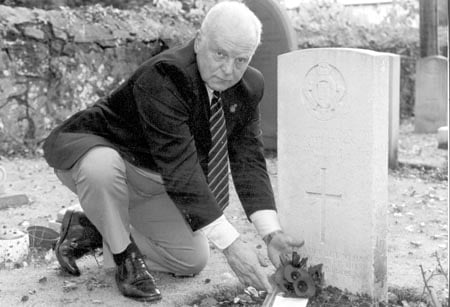
A LONE headstone in the cemetery at Beachley's St John's Church goes unnoticed in a week when we remember Britain's war dead.
It marks the grave of a young apprentice killed when a Luftwaffe bomber believed to be a Junkers JU88 dropped a 1,000lb bomb on the then Army Technical School at Beachley.
Keith Underwood, a lad living nearby at the time whose father worked at the camp, recalls that ironically the bomb itself did not hurt anyone and failed to go off. Relief was short-lived.
"Staff and apprentices were thronging the camp and the plane turned and strafed the area, killing Apprentice Tradesman Thornton and badly wounding a sergeant," he said.



"My father attempted to shield the boy, but he had already been hit.
"The plane, as was customary, had split off from its group to search for its target, possibly at Filton or Yate, when it is believed that it came under fire from a floating battery in the river. Turning, it recognised the school as a military site."
Mr Underwood, who is now an organiser with Beachley Historical Society, lived in Pennsylvania Village on Offa's Dyke in what is now Sedbury.
He says the camp must have stood out like a sore thumb but although they spent many nights in the garden air raid shelter the planes droning overhead carried on to Bristol.
The lone raid on Beachley took place on November 9, 1940 and Bristol came under the heaviest attacks of the war from November 24. The destruction was widespread – at least 200 died while some 700 were injured, and many were left homeless.
The flaming skies above the city are a lasting memory for Mr Underwood, who was allowed to raise his bedroom window blinds to look across the river at night.
"On one occasion it seemed lightning had set fire to the balloon barrage. It was an astonishing sight to see the balloons dropping from the sky, blazing," he said.
With fellow historian John Furley of the Beachley Old Boys Association he is recording the wartime stories and relics of the era for future generations.