
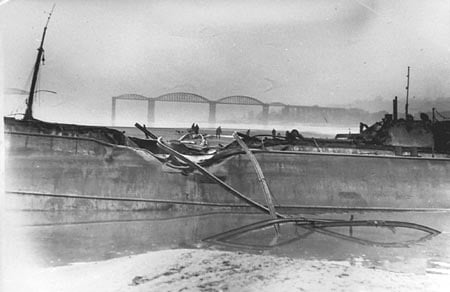
SEVERN fog gives no notice of its coming. Thus on the night of October 25, 1960, the sprint to the comforts of Sharpness held no fear for the experienced crews of the fleet of tankers heading up river.
There had been wispy mist further down Severn but opposite Lydney the veil fell thickly over the fleet of vessels seeking the Gloucestershire port.
Among them were the Arkendale and the Wastdale – the Arkendale carrying 298 tons of fuel oil, and the Wastdale 360 tons of motor spirit.
At first there was no confusion but as the official report later concluded: "...dense fog developed rapidly and the area became hazardous for navigation."


Both vessels found themselves above the entrance to Sharpness. The story has been told many times but, simply, the vessels collided and could not be separated. Locked together, they were swept towards the bridge which loomed suddenly out of the fog.
The Wastdale struck a bridge pier, heeled over to port on her beams end and caught fire, the fire spreading to the Arkendale. The impact and the explosions which followed brought down two sections of the bridge as the crews abandoned their vessels and struck out for the shore.
It was the start of a night of high drama as a sheet of blazing fuel spread swiftly across the river.
Sadly Percy Simmonds, mate of the Arkendale and a well known Cinderford boxer was to lose his life.But his crewmate, George Cooper, of Buckshaft Road, Cinderford, somehow hung on and was later rescued by a boat and landed at Lydney where he was taken to hospital.
The Arkendale's captain, George Thompson, of Gloucester, was found on the river bank by Mr Peter Warner, of Poulton Court, and Mr James, Dew, captain of the Wastdale, came ashore near the Severn Bridge where he was cared for by Mrs Harris at The Severn Bridge pub.
The full impact of the disaster was revealed at dawn the next day.
A Court of Enquiry convened by the Minister of Transport concluded that there was no fault in navigation for which the masters could be blamed but suggested improvements could be made to warn masters of deteriorating weather conditions.
Then the talking started. There was talk and more talk until, eventually, it was decided the bridge should be dismantled.
•Have you a Severn Bridge memory? A story to tell about that tragic night or a happier one of family picnics by the bridge or a Sunday School trip to the Pleasure Ground at Sharpness. Please put pen to paper and let us know.