

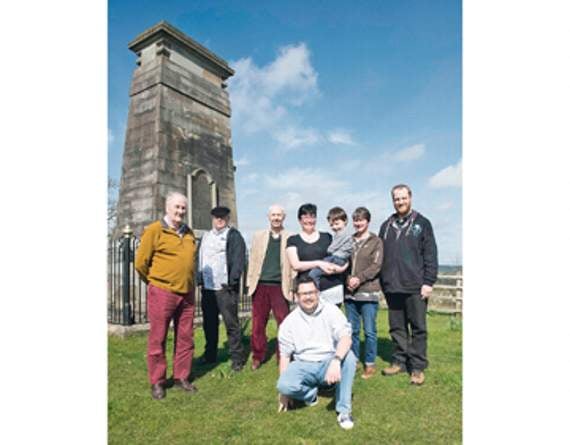
A VILLAGE war memorial which was based on the national Cenotaph in London has been listed as a site of special historic interest.
Historic England granted grade II-listed status to Bream Cenotaph after volunteers from the village’s library researched its history and made an application.
Unveiled on Sunday, September 11, 1921 by General Tyler, and dedicated by parish vicar Rev CHT Wright, it includes the names of 21 local soldiers who gave their lives in the First World War a century ago, and 25 service people from the Second World War, including two women.
Researchers at the library were ‘greatly helped’ by local historian Ian Hendy’s book Retrieving Wenty’s Sturty Bird – The Story of Bream Cenotaph 1921-2001.


Wenty was a young Bream lad who lost his stick – a ‘sturty bird’ that you whacked through the air as far as you could – inside the partially constructed monument.
Volunteer researcher Paul Stephens-Wood said the monument’s cost of £750 was paid for by public subscription from the Bream parish, including £250 from the owners of Princess Royal Colliery, the village’s major employer, £250 from the employed miners (deducted from wages), the Soldiers and Sailors Presentation Fund begun during the war and door-to-door collections.
At the unveiling ceremony, another collection was made for railings to protect the monument and wreaths from roaming sheep.
Sited on Sun Tump opposite the Rising Sun pub, it was constructed in local sandstone from the United Stone Quarry in Parkend and constructed by HJ Walker of Bream.
Mr Stephens-Wood added: “The Bream memorial was designed as a smaller copy of the national Cenotaph at Whitehall in London.
“The architects were Kennard and Kennard of Grey’s Inn Square, London, and the main differences in design with the Whitehall Cenotaph is that the Bream monument has a stone cross set into the north side above the inscription and list of names of those who died in World War One, and an inscription “To our glorious dead” not simply “The Glorious Dead”.”
The west face has a plaque commemorating those who fell in the Second World War, with another plaque at its base dedicated by Forest of Dean’s Burma Star Association branch.
The two women commemorated are Doreen Brooks and Dorothy Hancocks. Doreen, known as Dora, was in the Women’s Auxiliary Air Force (WAAF) and died from TB in 1946, and it was thought her war service had been a factor in her final illness.
Dorothy was a munitions worker who died in 1940 from acute poisoning from TNT.
There is also a dedicatory inscription on an iron plaque marking the laying up of the Burma Star Association’s standard in August 2005, the 60th anniversary of the end of the Second World War.
As well as Ian Hendy, Mr Stephens-Wood also praised the work of Phil Morton and the family history society for researching the biographies of all those commemorated on the cenotaph.
Historic England are listing war memorials across the country as part of their centenary commemoration of the First World War.
And Mr Stephens-Wood added: “We hope that other war memorials in the Forest will also become grade II listed to help preserve and protect them for future generations.
“We will be happy to share their knowledge with any individual or group that wants to apply to Historic England for their war memorial to be included on the list.”
They can be contacted via www.breamcommunitylibrary.co.uk
Comments
This article has no comments yet. Be the first to leave a comment.