
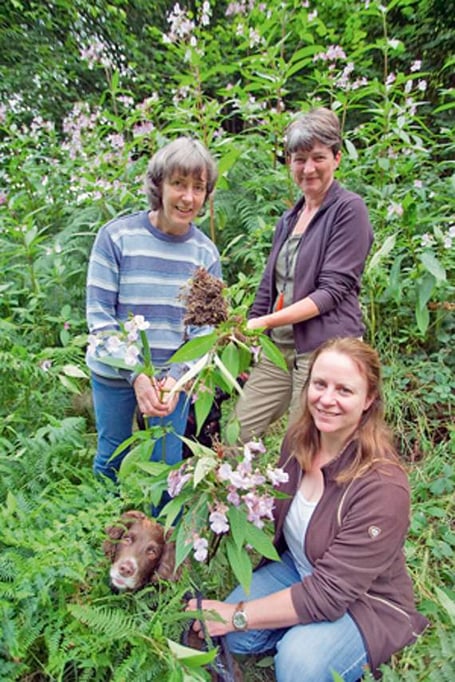
A TEAM of friends in Bream who call themselves the Balmy Army has stopped – for now – the rapid growth of an intrusive foreign weed that is becoming a nationwide problem.
Sarah Fowler says the Himalayan balsam, which she described as a pretty pink flower, has been growing at a tremendous rate around the village and towards Knockley and Parkend.
Gloucestershire Wildlife Trust says the government estimates it would cost around £300m to eradicate.
Ms Fowler said: “Although it’s not poisonous it is becoming invasive along popular dog walking tracks which we use and has the potential in the long-term to take over. I have lived in the Forest for the last nine years and first noticed it around four years ago when my dog walked through the weed and the seeds literally exploded.”




The self-employed chartered building surveyor says it was during a lecture in May 2013 that she learned about invasive plant species, which ones to look out for, and how they affect buildings or developments.
She said: “I hadn’t been aware before then of Himalayan balsam and from then, started to recognise it on my daily dog walks.
“While not a physical threat to buildings or structures, property and land owners need to be aware if they have it growing on their land, not to allow it to spread beyond their boundary.”
Since then Ms Fowler and friends Alison Bruce and Mairi McLellan have tirelessly pulled up hundreds of square metres of Himalayan balsam. In the last year only three plants have re-grown.
Sarah said: “The good news is pulling it up from its root over a period of three years will completely remove it. The next best thing is to cut it down before flowering to stop it seeding and spreading.”
Introduced to the UK in 1839 the weed grows in gardens, allotments and riverbanks. It seeds in September and October and is seen between spring and autumn. It’s advised the best time to treat it is early summer.
A spokesperson for the Gloucestershire Wildlife Trust said: “Himalayan balsam spreads quickly alongside water courses and in damp areas. Among the problems it poses are that it is highly invasive, holds back water and increases the risk of flooding.”
The flowers can produce up to 800 seeds which open explosively when ripe and disperse up to 7m (22ft) away.
The plant is spread either by humans passing on seeds or by water.
Ms Fowler added: “Only with the dedication of people on the ground pulling it up in the less accessible areas coupled with the Forestry Commission cutting the vast areas on the verges and gullies, will we stop it taking over the Forest.”
To report locations where it’s growing on council or Forestry Commission land, email [email protected]
Comments
This article has no comments yet. Be the first to leave a comment.