

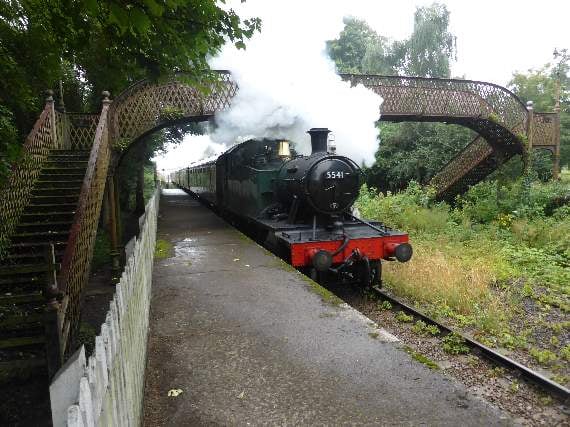
WORK will start next week on restoring an historic Victorian footbridge over the Dean Forest Railway (DFR) that has been closed for more than a decade.
Bridge specialist Mabey, based in Lydney, has been appointed to undertake vital repair and restoration work on the town’s St Mary’s footbridge, which will begin on Monday (June 18) when the crossing begins to be dismantled.
Over six days, sections will be lifted out by the DFR’s own rail crane, transferred to road haulage and taken to a secure workshop for restoration and repair.
During the dismantling, the site around the bridge – which borders St Mary’s church, Bathhurst Park and Lydney boating lake – will be closed to the public for safety.
_edited.jpeg?width=209&height=140&crop=209:145,smart&quality=75)


The cost of the works has been put at £150,000, but the DFR, which runs the railway between Lydney and Parkend, has now secured funds to restore the last remaining piece of original Severn and Wye Railway infrastructure.
Built over 125 years ago, the Grade II-listed iron footbridge over the tracks was closed for safety reasons in 2007 and has since fallen into further disrepair.
As the last in-situ piece of the original railway, it is a unique piece of historical Railway heritage.
A public right of way linking the town and the boating lake with Church Road is routed over the footbridge and so the 11-year diversion along a short detour via the bypass will at last be lifted after the bridge’s reinstallation.
Walkers will welcome the bridge’s restoration, which was originally built to eliminate accidents caused by people scrambling across the tracks.
Cllr Brian Pearman, Deputy Mayor of Lydney, said: “The restoration of this bridge, which is an asset to both DFR and the community, is welcome on a number of levels.
“The bridge is a crucial link in connecting different parts of the community, fitting into other non-vehicular routes drafted by the Lydney Neighbourhood Development Plan and the Coastal Communities Team.
“An added bonus is the involvement of Mabey Bridge Ltd, this being the company’s second community bridge project following the successful restoration of the canal swing bridge.”
The historic structure in the Lydney Conservation Area will be restored thanks to Rural Development Programme for England; Rural Tourism Infrastructure Growth Programme Funding, Dean Forest Railway. St Mary’s Pedestrian Bridge Project is also part-funded by the European Agricultural Fund for Rural Development.
Michael Treacy, CEO of Mabey Bridge, which manufactures and exports modular bridges around the world from its Lydney factory, said: “We are delighted to be involved in this, a project very close to our hearts.
“While we build and maintain bridges across the world, there is something special about restoring a bridge that is so well-loved by the local community and our employees alike and celebrating an important part of Lydney’s history.”
DFR Project manager Jane Kelly has described it as a “a jewel in the crown of Lydney’s industrial heritage.”
She said: “While restoring an important piece of history, the restoration will also enable free, all year round, heritage railway tourism, such as trainspotting, for the benefit, appreciation and enjoyment of the local community, visitors and future generations.
“Thank you to everyone who gave their support to our application for funding. The grant would not have happened without the backing we had, not only from local organisations, but older residents who would use the bridge daily as children.”
The listed footbridge, which is on the ‘Buildings at Risk’ register, is a strong reminder of the town’s growth and dependence on the railway and docks.
Rail historian Neil Parkhouse said the railway was opened in 1868 on the route of the old Severn and Wye tramroad, and its heavy use ferrying coal to Lydney Docks saw the bridge constructed at St Mary’s Halt in 1892.
With workmen from Lydney Tinplate Works crossing the line near the engine shed and works sidings, plus people attending church services taking the shortest route, the Severn and Wye Railway (SWR) feared being liable for a major accident.
And although a long trade downturn meant severe financial difficulties for the firm, they funded the new bridge for the sum of £267, built by Glasgow firm G Smith and Co and opened on September 26, 1892.
Children loved the new bridge’s handrails for sliding down, but their fun was ended in 1901 when iron nuts were fixed because of fears that youngsters might fly onto the iron railings below.
St Mary’s Halt station, where a River Lyd culvert crosses beneath the track and bridge, was reopened by FDR in 1991, but closed again in 2014.
Forest planners have granted listed building consent for the works, even though the bridge will be dismantled in separate sections.
Project manager Jane Kelly described the bridge as “as much needed today as it was when it was built in 1892.”
Comments
This article has no comments yet. Be the first to leave a comment.