
I'M very sorry that I'm unknown to Mr Belcher's social
network in Coalway, as he points out in his letter 'Mining
Realities.' Quite obviously because I'm a recent incomer,
foreigner, "Gast Arbeiter" or whatever term identifies a

new resident recently arrived.
Thomas Hardy has warned us in his novel 'Tess of
the D'urbevilles', with dire consequences, about the
dangers of leigemen (and women, in the case of Tess)
identifying themselves by claiming supposed aristocratic
English ancestors.
However, the Ortons did accompany the King in the
13th / 14th century on his Scottish Wars; John de Orton is
listed in Joseph Foster's Dictionary of Heraldry (first
published 1902) on Edward III's Roll of Arms (1327 -
1377): "John de Orton bore azure,a lyon rampant argent,
(Jenyns Ordinary.) Same as: Sir Robert de Monthalt,
baron,1299, (Henry III's Roll of Arms) bore the same at
the battle of Falkirk 1298, Siege of Caerlaverock 1299,
sealed the Barons' letter to the Pope, 1301. (John Orton
bore the same. John differenced it with a label (3), or,
(Jenyns Ordinary): a label (5), gules, (Arden and St George
Rolls), and also with the field, or, (also in the Arden Roll.)"
The Cumbrian Ortons still carry the main device
"silver/white lion rampant on blue" but my leigelords, the
Ortons in the East Midlands, carry a Tudor rose over
chevrons because their lands were bequeathed by
Elizabeth I to Leicester, Earl of Essex . There is evidence
that there were Midlands infantry and sappers at the Seige
of Caerlaverock.
That little bit of ancient lore might identify me as
just another Englishman in Coalway.
I'm also sorry that when I was nine I wasn't down the
pit gaining the direct experience Mr Belcher describes so
graphically, and that would have been so beneficial in
curing my romanticism about iron mining . All I can
remember 'digging into my back' at that age was a silver
die-cast Roy Rogers' cap pistol as I was rounded up by
one of the other village kiddies as we played at cowboys
in the fields. (I might have been Hopalong Cassidy; I
might have been Tom Mix.)
Regretfully, I have, also, very sparse work
experience credentials for commenting on the iron mining
industry as Mr Belcher recalled it. In 1964, at the tender
age of 19, I worked for less than one year with the Iron
Ore Company of Canada at the open cast mines at Knob
Lake, Labrador near the town of Schefferville, Province
Quebec.
My job specifications were:
1. Mounting and polishing samples for photo-
micro-spectrograph analysis by the mineralogists.
2. Helping maintain the flotation unit in the
experimental iron ore pelletizing plant.
3. Sitting in a Chevrolet truck with the engine
running, four hours on, four hours off, at the head of the
open-cast mine, with a load of tin cans, with which I
could clamber all over Caterpillar trucks to sample the
iron ore on its way to the rail head.
I slept in a bunkhouse at the mine. All food and
non-alcoholic beverages were available free of charge
night and day, with T-bone steaks once a month, The lack
of female companionship meant there were dangers of
alcoholism, freezing at 40 degrees below zero, or getting
bushed (that is, wanting to take your time-off or
holidays further north; Hudson Bay, Baffin Island or other
Arctic locations.)
I earned a lot of dollars in a short time but foolishly
gave up the job to hitch-hike down to the United States
to gain some love and admiration for being English in
America at the same time as the Beatles and the Rolling
Stones.
So, a sad catalogue of direct, industrial, iron-ore-
mine experience really. A bit romanticised also as I drift
into old age, I suppose, as Mr Belcher has written. But I
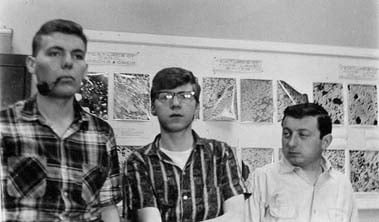
have photographic evidence that I was there with the
mineralogists at the Knob Lake Laboratories. I'm the one
in the middle.)
– Joe Orton, Coalway.
Comments
This article has no comments yet. Be the first to leave a comment.