
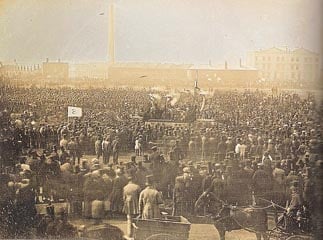
A ST BRIAVELS man is invoking the name of the infamous Chartist movement of the 19th century to call for political reform.
However it remains to be seen if the group he represents has the drive and courage of its erstwhile champions of people's rights, who stirred the country to a frenzy and faced being hung, drawn and quartered for their beliefs.
Carl Spiby told the Review: "170 years after the original trial at Monmouth, Chartists are making their timely return. Once again their aim is to challenge the status quo, and to make strong the case for policies that reflect the interests of ordinary working people.
"Amid a political crisis where our Parliament has lost its moral authority (assuming it actually had it in the first place!), a public meeting will take place at the Queen's Head pub in Monmouth on July 11 (1pm). Come hear our programme: 'The People's Charter' and how it is the real charter for change."
.jpeg?width=209&height=140&crop=209:145,smart&quality=75)


Points called for in the 'new charter', flagged up on the website http://www.thepeoplescharter.com">www.thepeoplescharter.com include introducing a progressive and fair system of taxation minus the loopholes or tax-havens for the rich; restoring the link between earnings and pensions; increasing the minimum wage; massive investment in green technology to help us through the global downturn and to safeguard our children's future environment; stopping repossessions and building three million sustainable and publicly-owned homes; protecting the NHS from creeping privatisation; renationalising key services, from energy to the postal system and water, for proper investment and service continuity to benefit the people and not the profiteers of essential services; and no more billions for nuclear weapons when nurses and teachers are needed to help build a socially-just future for all.
Mr Spiby would not be photographed as one of the organisers of the proposed new chartist movement, suggesting we use a portrait of Chartist leader John Frost, transported to Tasmania after his hanging sentence was commuted.
Frost, from Newport, was arrested and charged with high treason and early in 1840, and along with William Jones and Zephaniah Williams, was tried at Monmouth's Shire Hall. All three were found guilty and became the last men in Britain to be sentenced to be hanged, drawn and quartered.
However since then all but the last of their six demands have come into being:
•Universal suffrage for all men age 18 and over
•Equal-sized electoral districts
•Voting by secret ballot
•An end to the need for a property qualification for Parliament
•Pay for Members of Parliament
•Annual election of Parliament.
The clarity – and brevity – of this message no doubt helped the original cause.
Comments
This article has no comments yet. Be the first to leave a comment.