

EXACTLY a century ago this week an entire Forest village was “evacuated”, although the forced move was not for the safety or benefit of the uprooted people.
The story of what might be more accurately described as a mass eviction at Beachley has largely been forgotten – until now.
A new book throws a fascinating light on how fears about U-boats in the North Atlantic blighted a village, led to a campaign for justice that lasted a decade, provided money-making opportunities both legitimate and dishonest and led to a rural backwater being transformed into a massive industrial centre.
Carol and Richard Clammer of Tutshill first became aware of the evacuation when it was mentioned in a book Carol was helping with on the churches of Tidenham by the Tidenham History Group.
.png?width=209&height=140&crop=209:145,smart&quality=75)



Carol said: “There was a chapter about Beachley Church which people in the history group had already researched. There were two pages about the evacuation of the villagers which we knew nothing about and we had been here for 28 years.”
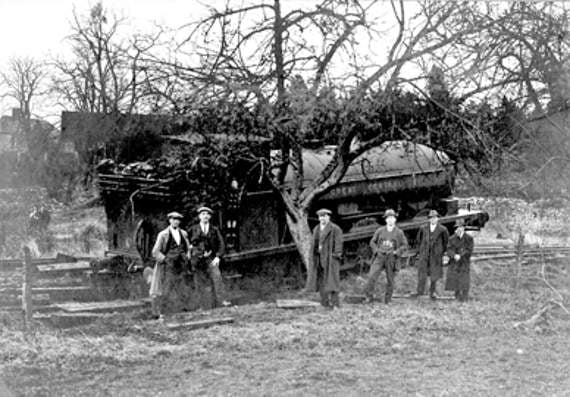
But what really kicked it off was a photo from Mr George Grail of former Great Central locomotive 404B derailed from a section of line running through Mead’s Orchard and with Tump Farm in the background.
Richard said: “We spent happy winter days walking around with this picture trying to work out where it was.”
Some four years of pain-staking research in the local area and in archives in Gloucester and London has resulted in Beachley and the First World War: The Story of a Shipyard, a Railway and the Transformation of a Rural Parish.
It tells how government letters were delivered to every home in the village on Monday, September 3 1917 giving families just 11 days to move.
Following the deadline of September 14 soldiers from the Royal Engineers and German prisoners of war moved in to begin work on a giant shipyard.
Beachley, along with Chepstow and Portbury, on the other side of the Severn, were to become the sites of three ‘National’ shipyards but the venture would end in scandal with no ships ever being built on the English side of the Wye.
Carol said: “The bits that were known had been rehashed in various documents but there was no detail about the amount of change or what happened to the people who left the village.
“I think there were at least 106 individuals that were evicted. When you go through the (1911) Census returns it’s a bit difficult to work out.”
The only person who was not moved out was Mr Blatchford, the lighthouse keeper – whose granddaughter still lives locally. He had to stay to tend the lights to guide ships through the Severn.
Former teacher Richard said: “It was a rural idyll and then, wallop, in came 3,000 Royal Engineers and 3,000 prisoners of war in a month.”
Among those affected were the local bigwigs, the Curre family at Beachley Lodge – the site of which is now the officers’ mess at the army barracks – and Colonel Percival Marling VC who was at Sedbury Park.
The Curres were moved out, never to return, and although Col Marling had land seized, he was allowed to stay but he would leave the area after receiving his compensation in 1920.
Richard said: “ It’s typical of the time – there is endless detail about compensation for the landowners.
“There are some wonderful details about the Curres and it’s down to how many cabbages and carrots they had in the field, how many pots in the potting shed and how many rings on the curtain rails. It is that detailed.”
There are many letters in the archives complaining about the lack of compensation.
Carol, a former adult education manager, said: “The solicitors’ reports and everything have been archived so we could see the development of the angry letters as people got crosser and crosser about not getting compensation or being offered compensation that never appears or is quite inadequate.”
Amelia Saunders, who owned the Three Salmons pub, had to wait until the end of 1927 for her compensation claim to be sorted.
The pub, which was run by Amy Boyle, was part of one centre of population with the other being around the pier.
Carol said: “It was all considered one village but quite what happened after the 1911 census up to 1917 when they were evicted, we’re not really sure but I would imagine there would have been a huge amount of change.”
The couple have managed to trace what happened to most, but not all, of the families – it is thought some stayed with relatives and others were put up in the parish but there are no official records.
Col Marling put up some of his tenants but then insisted the military provide homes for them so the government built what is now Tubular Terrace and Buttington Terrace.
The evacuation and the treatment of the villagers received widespread and sympathetic coverage in the newspapers.
Richard said: “In terms of a huge war effort it is nothing but for some reason it pricked the national conscience, probably because Marling was so influential.
“It was all over the national newspapers and we’ve got an article from a New Zealand paper about the ‘death of Beachley’.”
Carol added: “It pulled at the heartstrings because it had been a small, close community: rural, fishing and a bit of a tourist attraction.”
Worldwide sympathy or not, the government was more concerned about the shipping lost to U-boat action at the beginning of 1917 which threatened to cut off essential supplies.
Richard said: “It was going to be huge – there were 18 slipways in the original plan, five of which were built or started and a wet dock for fitting out which was abandoned.”
There was also the biggest shed in the world, a 1,000ft long fabrication facility, the centre line of which is now Inner Loop Road.
Today, bits of railway line and concrete blocks, made by the prisoners on what is now Pavilion Road for the buildings, can still be found in gardens.
There are pictures of the development of the yard and railways thanks to a chance discovery in the archives of the Imperial War Museum.
A researcher looking into Richborough in Kent came across two misfiled government albums showing the Beachley development and alerted Forest railway historian Neil Parkhouse.
Richard said: “It was a Eureka moment. We would never have found them in a million years.
“These wonderful military photographs, all dated, orientated and mapped, show the building of it in 1918.
“They are stupendous because they give these wonderful pictures of the whole thing, of the shipyard and the prisoners of war.”
Carol and Richard say the assistance of Tidenham Histoy Group, other historians and various railway and prisoner-of-war experts were crucial in the development of the book.
“We’ve been careful because we are not railway historians – we’ve had a huge amount of help from the Industrial Locomotive Society, the chap who designed the book is a railway historian and Neil (Parkhouse) of course.
“The railway was driven in first from Snipe Hill – it was a big railway system but this is a branch line that has never been written about.
“We’ve managed to find the whole history of the building of the line, track diagrams and lots of photographs.
“It came down Sedbury Lane and through Sedbury crossing down by Box Cottage by Pennsylvania (village).
“There were loads of sidings down to the wet dock and the slipways and lots of locomotives, standard and narrow gauge. We have a big appendix of every locomotive that was there.”
There were also ‘lines’ of mainline RODs – the Railway Operating Division of the Royal Engineers – locomotives which were stored at Beachley after service on the Western Front.
There are remnants of the railway system, including track and platforms, “if you know where to look”, said Richard.
Among the many stories about the site is a report in The Times in 1919 that a locomotive had gone missing and another that the commanding officer had ‘lost’ two fields.
Richard said: “There were at least six narrow gauge locomotives down there, most of them we’ve accounted for being auctioned or sold or moved somewhere else. There are couple which we are not clear about.
“The local farmer says there is a train here somewhere and people keep telling us this story. “Whether it is just a folk memory or whether lurking somewhere under a field in Beachley there is a narrow gauge steam engine, we don’t know.”
Richard says his favourite tales from the yard are the so-called ‘eye-wash’ stories where managers tried to pull the wool over the eyes of inspecting top brass.
He added: “By the time of the Armistice, it was pretty much finished but there was no need for it – it never built a ship.
“There are some wonderful stories about paths being built, trains being put in front of things they didn’t want them to see, stones being painted and the prisoners being told to bang on metal sheets to sound busy.”
There was an attempt by the government to hand the running of the yard over to the trades unions – the Severn Estuary was originally chosen because it was far from traditional shipbuilding centres and union influence – but that failed.
Richard added: “It was so big the government, gave over the whole disposal thing to a private company which must have made millions.”
There were other, illegal, ways of making money from the shipyard and there are many reports such as the man brought before magistrates after trying to do a deal in a local pub for stolen roofing materials.
Carol said: “All sorts of local ne’er-do-wells were being nicked for receiving stolen goods. It was rife.”
Eventually much of the site was given over to become the Army Apprentices’ College which opened in 1923 and is now the base for 1 Rifles.
Carol said she would like to find out more about who came back to Beachley and where they had been during the evacuation.
The 192-
page book
features many contemporary photographs including, bizarrely, some taken by an enterprising
Ross-on-Wye photographer of German prisoners of war as a ‘souvenir’ of their time in the camp.
It is published by Black Dwarf Lightmoor and is officially launched on Sunday (September 17) at a public event to commemorate the evacuation which starts at 2pm.
Richard and Carol will also give an illustrated talk about their research at an event hosted by Chepstow Bookshop at the Drill Hall in Lower Church Street, Chepstow on Tuesday (September 19).
Richard said: “We’ve tried to write an accessible story for the general reader but it has footnotes so other people can follow and carry on the research – we both feel a good history book is something you can pick up and think” ‘this is interesting’.”
Comments
This article has no comments yet. Be the first to leave a comment.