

IMAGINE being taken to an unfamiliar environment, being given the challenge of finding an opportunity to make improvements and then having to design and make a solution for it.
That, in a nutshell, is what teenagers studying A-Level product design are asked to do and some of the solutions of students at Wyedean School in Sedbury went on display — along with work by GCSE pupils — at an exhibition attended by more than 200 people.
The 10 students on the A-Level product design course worked with the Heart of the Forest special school near Coleford and the Morello physiotherapy clinic at Langstone near Newport.
Mr Ben Gibson, a teacher of applied design technology at the school, said: “The students have worked with the Heart of the Forest school and Jakko Brouwers, a physiotherapist at the Morello Clinic in Newport on an inclusive design project.




“They went to the two sites and they have to find a brief, write it and then they have a year to design and make the products.
“We have an exhibition at the end of the year where we display the final solutions at A-Level and GCSE.
“We had about 200 people to the exhibition and we take feedback which the students use in their final evaluations.
“The last part of the project is to propose improvements based on that feedback — there were lots of positive comments and the thing that came back strongly was how much people enjoyed talking to the students and getting their perspectives.”
Among the designs were several that were “degree level”, said Mr Gibson, and “the range of manufacturing processes and techniques is really good.”
As an example, he pointed to the work of Evie McGinley, who worked with a woman who uses a wheelchair after being involved in a cycling accident, on an improvement to a shopping trolley.
Evie said: “There are similar products, but they are quite clunky and frustrating to use. I wanted to improve that.
“My trolley uses copper and aluminium piping and plastic, so it is lightweight and would be easy to manufacture.”
Mr Gibson said: “The solution she has come up is commercially viable on many levels — her brief was to make it more user-friendly, scale it down, make it lighter in weight and make it more accessible for a wheelchair user.
“I think she has done that on lots of levels, it fits to the wheelchair really well, the ergonomics are really good, it’s lightweight, so she has hit all the user requirements.
“She has hit the requirements for the supermarket, which would be the customers as its nestable, has branding and is stylised, and also the manufacturing requirements in that it is made of cut tube and moulded plastic, is easy to assemble and cheap to mass produce.”
Alex Presley designed a rotating board to help the rehabilitation of people with ankle problems which even comes with differently sized slopes to adjust the resistance.
He said: “Jakko has a static board, but I thought adding rotation would make it feel more natural.”
Peter Jackson also worked with the clinic, but the device to help people recovering from shoulder injury could also be used as a game by children.
“The physio can be at one end interacting with the patient but it could also be used as a game,” he said.
“It works to strengthen the shoulders and lateral muscles and it’s based loosely on a children’s game.”
Francesca Moorlen designed a “chill out rocking chair” inspired by pupils at the Heart of the Forest school and built using recycled industrial cable reels.
She said: “They get excited going between lessons, so this could be somewhere to relax for a few minutes so they are ready to learn.”
Mr Brouwers, who lives in Woodcroft near Chepstow said he was “amazed” at the ingenuity of the Wyedean students.
He said: “We have really enjoyed working with them. They came to spend time with our patients and had opportunity to see some specialist treatment equipment.
“We then had a brainstorm about where equipment is not helping our patients and they identified design opportunities. Some worked with individual patients on a problem they had encountered.
“I am really amazed with the ingenuity shown by these students and the quality of the designs they have come up with, some of which could be suitable for a wider disability market.”
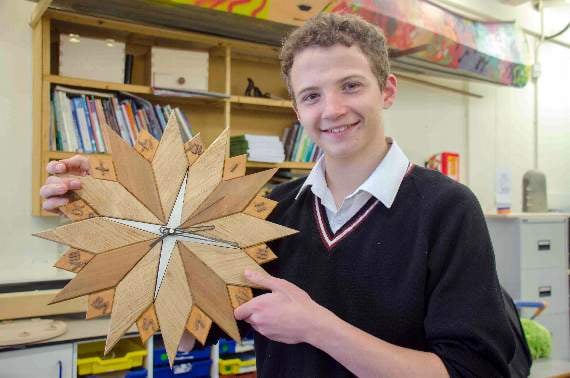
The GCSE students based their designs on artistic movements such as Modernism and Art Deco and used a wide range of techniques, including spot welding and moulding molten metal.
Jacob Rees made an Art Deco clock because he needed a timepiece. The wooden surround was carefully cut and he then sanded the wood until it was the correct size “which took a lot of patience.”
The centre was made by moulding pewter, which has a melting point of more than 225 degrees centigrade.
Katie Pitt took inspiration from the Modernist movement, which puts a premium on function, when designing her hexagonal, wall-hung shelves.
Sophie Davies said the design for her herb planter had changed considerably from her initial ideas and it now features three bays which can be arranged to grow one or more plants.
She said it was specifically designed with people who do not have gardens to allow them to grow their own herbs.
Finley Wood turned to concrete to make the housing for his Modernist light and chose the popular arrow motif for the shape.
He said: “It’s an easy material to work with but you have to get the proportions right when you mix the concrete.”
Comments
This article has no comments yet. Be the first to leave a comment.