
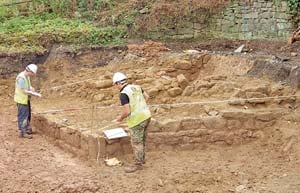
THE remains of a medieval stone tower have been found in the grounds of a Forest school.
The 'exciting' discovery was made as preparations were being made to build a new classroom block at English Bicknor Primary School near Coleford.
It was previously thought that the castle was a motte and bailey type where the fortification is on top of a earthwork.
Experts were surprised at the discovery of the two-metre high base in what was thought to be the moat of the castle.




Gloucestershire County Council, which commissioned the new three classroom block, has been working with Hereford-based Headland Archaeology and English Heritage which has declared the find of national importance.
Andy Boucher, regional manager at Headland Archaeology said "This is a very exciting discovery.
"It shows this was in fact a keep and bailey castle which are usually very early in date.
"In this case it seems to have had a gatehouse keep and the remains we found could have been the base of one of two towers flanking the gate. "The main contractor for the work, Pod Space, were able to come up with a design that will preserve these nationally significant remains."
It is known that William FitzNorman – who was born in the Forest of Dean before the invasion by William the Conquerer – was lord of the manor at the time of the Domesday Book in 1086 and it may have been his castle.
After the tower was discovered on the corner of the site a new location for the classrooms was agreed and was made possible by the village hall committee ceding land to the school.
Transfer of the land has allowed the school access to be widened and additional playground will be created to compensate for area lost by the relocation of the building.
Head of English Bicknor Primary School Mrs Hayley Alliston said: "The children are looking at castles and will be looking at the school castle itself.
"The archaeologists will also be coming back into school to talk about the discovery and the process they undertook."
The stonework is said to be in 'pristine' condition but has had to be covered over because of the cost of conservation.
Comments
This article has no comments yet. Be the first to leave a comment.