
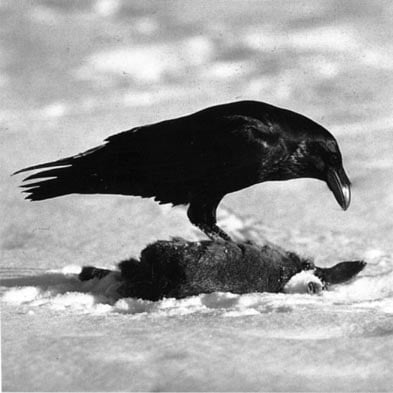
FEBRUARY is the ravens' month. On February 2 I found a raven's nest newly built. They are always early and when they start nest building and egg-laying they herald the start of a new season for wildlife.
Telling a raven from a crow or rook is one of those things that is easy when you get used to it.
Ravens are the largest of the whole family of perching birds but size can be difficult to judge if you see a bird on its own. A raven has a wing span of four feet and a length from beak to tail of two feet. It's a big bird.
Last year I saw one flying over Russell's Enclosure close to a buzzard and the two birds were much of a size. Another way to recognise a raven is its deep croaking call, and despite its large size it is wonderfully acrobatic having a habit of tumbling or rolling right over on its back in aerial display.
.png?width=209&height=140&crop=209:145,smart&quality=75)



Ravens nest over most of the northern hemisphere and are equally at home on the arctic coasts of Greenland or in the deserts of North Africa. In all its range the only place where it is missing are the eastern United States, lowland England and central Europe. It is no coincidence that those areas are densely populated by man.
Its relationship with man has always been uneasy but it is not a bird that could ever be ignored and it is deeply imbedded in human folklore, usually connected with wisdom or bad luck.
Two ravens were associated with the Norse God Odin. Every day they would fly out around the world and in the evening return to tell Odin what they had seen. Some North American Indians had a belief that in the beginning there was darkness, water and a raven and the raven created the world.
In Britain ravens are usually linked with misfortune and anyone who read Shakespeare at school will remember Lady Macbeth going on about: The raven himself is hoarse, that croaks the fatal entrance of Duncan, under my battlement.
Hostility towards ravens has reduced their British range to the highlands of the north and west. It is rare in the English lowlands and if anything it is declining in southern Scotland.
Happily in Gloucestershire it seems to be increasing and in the Dean we have a good population of ravens probably at as high a density as anywhere. I know of ten nesting sites and I certainly don't know them all.
Allowing for the fact that not all sites may be used each year ten pairs in and around the Forest could be regarded as a minimum figure. In the face of our general persecution of the crow family this tough old bird has hung on and survived.
Nesting sites are on cliffs or in trees or their man made equivalents. Natural cliffs in the Wye Valley are used and their man-made equivalents are the Dean's quarries, several of which have ravens' nests. The super perpendicular architecture of Gloucester Cathedral also looks rather like a cliff face as far as ravens are concerned and in recent years a pair have nested successfully on the tower.
Tree nests can be difficult to find. Some years ago a pair nested in a stand of red cedars near Little Drybrook and the nest was quite invisible in the dense evergreen foliage.
Ravens are often seen south of Brierley but their nest is unknown to local birders and may be hidden away in the trees somewhere. The man-made equivalent of trees may not readily suggest itself but ravens have been recorded nesting on a pylon near Longhope!
How do you find them in the Dean?
Well their deep cronking call is very distinctive and might be hear anywhere. Probably the best frequented places where they can be found are at Symond's Yat where they nest on Coldwell Rocks close to the peregrine falcons and at Soudley Ponds where they can often be seen over the wooded ridge to the west of the ponds.