
HARDLY any of the locals let alone sightseers travelling along the winding road past Flaxley Abbey would know the crest of the hill above them has been occupied since at least 1,300 BC to the 13th century.
Or that today a man and his horse are toiling in the summer sun to preserve the ancient remains that our ancestors have left behind.
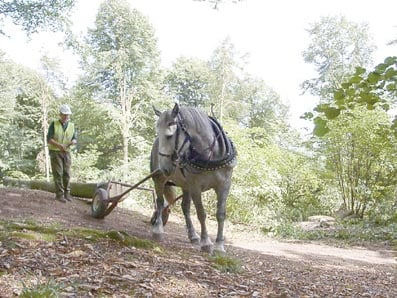
Doug Joiner and his trusty working companion Ella, a huge good-natured grey British Percheron, are carefully hauling felled timber off the soil and stone ramparts of Iron Age Welshbury hill fort and snaking it down between the trees to the forestry track at the bottom of a steep slope.
Doug is one of a select but sought after band of 'one man and his horse' teams engaged on this sort of work, which has far less impact on the terrain than mechanical removal.



.jpeg?width=209&height=140&crop=209:145,smart&quality=75)
"We can get in among the trees much more easily, without breaking up the ground," he says.
From mid-Wales, he has been on site for a couple of weeks now, camping alone with Ella and his three dogs at night, with about another week's work ahead.
The aim of the project is to cut back the biggest of the small-leaved lime trees which cover the immense system of earthworks, leaving their boles to form coppice clumps, explained Forester Peter Kelsall.
The Forestry Commission decided to take the softly-softly approach and hire Doug after discussions with county archaeologists and local history interest groups.
"We are only felling the biggest of the trees, where there is a risk of them being blown down – if this happens with the shallow-rooted trees there is a huge root-plate that comes up with them," said Peter.
"We are marketing the timber and it will be a bonus if we can make a profit from them but the primary aim is protecting the site."
Even this comes at a price, he said – coppiced wood will not allow the clear views of the earthworks we get at present.