
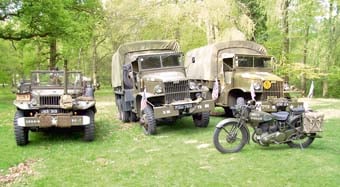
AN off-road military vehicle run by members of the Military Vehicle Trust is to be held later this month to mark the 70th anniversary of a Westland Whirlwind fighter which came down in the field behind Speech House in 1941.
The run, involving what's expected to be around 30 largely Second World War vehicles, will also explore what was once one of the most important munitions and chemical weaponry stores in the UK in the run up to D Day.
The inspiration for the run which will either start from Cannop Ponds or behind Speech House on September 17 is to commemorate the crash in 1941 which killed Sgt Pilot D E Prior aged 21. A commemorative stone is placed near the point of impact.
Jeremy Tobin explains the commemorative run will take in the Speech House area and surrounding forest which was the third largest above ground storage area for munitions including chemical weapons in the UK during the war.




He says munitions were brought in by train to Cannop and craned off before being transported by truck to various storage sites.
"It was an important storage site and small arms ammunition, weapons, shells up to 500lbs as well as chemical weapons were stored under the trees. The Americans also stored munitions there, but there aren't many signs left, were a few concrete stores and some corrugated sheds, but mostly it was kept camouflaged under the trees."
The run will leave the Speech House area around 11am September 17 and the organisers say they would like to thank the Forestry Commission, particularly Amanda Jones, for permission for this event to take place.
•The Westland Whirlwind which crashed on the morning of December 14, 1941, was part of 263 Squadron based at Filton. Pilot Sgt Prior was engaged on a searchlight co-operation flight, flying at 8-10,000 ft. A report says: "After a vertical dive he was killed instantly. It cannot be known whether he lost control in cloud or whether he was the victim of ice formation. He had been with the Squadron since Sept 12th 1941 and was popular for his sense of humour and excellent spirits".
The Whirlwind, a contemporary of the Spitfire and Hurricane was a British twin- engined heavy fighter developed by Westland Aircraft. It was one of the fastest aircraft when it flew in the late 1930s, and was much more heavily armed than any other. However, protracted development problems with its Rolls-Royce Peregrine engines delayed its production and only a relatively small number were ever built. During the Second World War only two RAF squadrons were equipped with the Whirlwind, and despite successful use as a fighter-bomber it was withdrawn from service in 1943.
Comments
This article has no comments yet. Be the first to leave a comment.