
THERE was never anything remotely romantic about mining. Forget images some modern writers portray of men whistling softly on their way to the pit, of joining together in groups to sing on their way home.
It was hard, heart-breaking and back-breaking work – and for many the only way to earn a crust if you happened to be born and bred in a mining community.
And that was the Forest of Dean.
Until the whistle blew for the final time at Northern United in 1965, many local families had no other option than to follow their forefathers underground.

.png?width=209&height=140&crop=209:145,smart&quality=75)

Cinderford councillor Graham Morgan made many a Forester sit a little less comfortably in his seat at The Speech House last week when he spoke up for the Northern Arc development. He was wearing his heart on his sleeve and his argument – though it won little acceptance – was fully appreciated and admired.
It begged the question that almost 40 years after the last big pit closed we still have to deal with the legacy of 2,000 and more years of mining. There are no easy answers.
Mining was about making money.
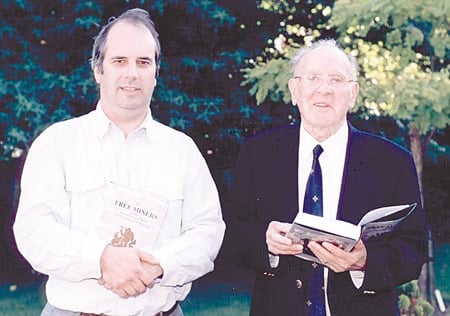
In his epic updated work 'The Free Miners', the font of Forest knowledge, Dr Cyril Hart, often refers to men working iron ore seams and coal to 'eke out a livelihood and for personal gain'.
And it was to protect themselves from outside influences – if you like, 'foreigners' nicking the loot – freemining was born.
Freemining, he says, most likely arose from a process of 'custom' or 'prescription' or, most unlikely, a 'lost grant'. It was certainly established by 1244 – and even then claimed by the miners to be 'from before the Conquest' – 1066.
A self-regulating Mine Law Court was extant from at least 1469 – the last was held in 1777.
It was around this time wealthy 'foreigners' took the reins and the iron and coalmasters ruled the roost until the end of the 19th century, before the demise of the pits under the National Coal Board in 1965.
However, the Free Miners battled on.
A series of attempts were made to extinguish or weaken freemining but there was – and, indeed, there still is, thank goodness – stubborn and resilient resistance to change.
Dr Hart puts it this way: "Acting under a strong sense of principle, and alarmed at what they consider and impingement of their rights, the situation has generated in the free miners a resurgence, reinvigoration and strengthening of their endeavours to safeguard their ancient customs and heritage. It remains to be seen whether their discontent will be satisfactorily abated."
So there could yet to another chapter to be added to this superb work.
'The Free Miners' is no dry tome. It is a weighty and expensive work at £36 but it is a 'must have' for all those interested in Forest history.
There is no greater authority on the Forest than Dr Hart. He is the Senior Verderer and this is probably his greatest work, though one must consider his other books – many now out of print – as contributing hugely to our knowledge and understanding of the Dean.
They are works of reference and the first ports of call for many many modern-day researches.
As much as it is a serious book of facts it is also a social history of the Forest – a reader can dip into any one of the 590 odd pages to find a little gem of information.
The new 'The Free Miners' brings up to date Dr Hart's first edition published half a century ago and Foresters should also be grateful to Lightmoor Press – Ian Pope and Neil Parkhouse – for taking on the publishing role.
There is a print run of just 500 copies. They are available in local bookshops.
Christmas is round the corner so get it now. It's the best ever Forest history book. JP